 Italiano
 English
 Español
 Русский
 中文
 Türkçe
 اردو
 Français
 Deutsch
 العربية
Hadith in anime
Il ragazzo e il re
Fonte e autenticità: Sahih Muslim 3005Sahih (authentic)
- Raccolta
- Sahih Muslim
- Narrazione
- Sahih Muslim 3005Riferimento nel libro: Book 55 (The Book of Zuhd and Softening of Hearts), Hadith 93
- Valutazione
- Sahih (authentic)Sahih Muslim 3005, Ibn Kathir, Jami` at-Tirmidhi 3340
- Riportato anche in
- Jami` at-Tirmidhi 3340
Traduzione: Qabas
Apri su sunnah.comUn re aveva un vecchio stregone, che gli chiese un ragazzo da istruire. Lungo la strada, il ragazzo incontrò un monaco e giunse a credere in Allah. Quando una bestia enorme bloccò il passo alla gente, invocò Allah e la uccise con una pietra. Guariva i ciechi e i lebbrosi, dicendo sempre che è Allah che guarisce. Il re torturò coloro che avevano creduto e per due volte cercò di uccidere il ragazzo, su una montagna e in mare, e per due volte Allah lo salvò. Allora il ragazzo disse al re l'unico modo in cui poteva ucciderlo: davanti a tutta la gente, dicendo «In nome di Allah, Signore del ragazzo». Il re lo fece, il ragazzo morì e la gente credette. Una storia sulla fermezza e sull'affidarsi soltanto ad Allah, ricordata nella sura al-Buruj.
Audio originale in arabo e doppiaggio in 9 lingue: scegli con il pulsante audio sul video, e i sottotitoli con il pulsante CC. Per guardare non serve un account.
Lo hadith
Traduzione: Qabas · Sahih Muslim 3005
Traduzione inglese verificata
Suhaib reported that Allah's Messenger (ﷺ) thus said:There lived a king before you and he had a (court) magician. As he (the magician) grew old, he said to the king: I have grown old, send some young boy to me so that I should teach him magic. He (the king) sent to him a young man so that he should train him (in magic). And on his way (to the magician) he (the young man) found a monk sitting there. He (the young man) listened to his (the monk's) talk and was impressed by it. It became his habit that on his way to the magician he met the monk and set there and he came to the magician (late). He (the magician) beat him because of delay. He made a complaint of that to the monk and he said to him: When you feel afraid of the magician, say: Members of my family had detained me. And when you feel afraid of your family you should say: The magician had detained me. It so happened that there came a huge beast (of prey) and it blocked the way of the people, and he (the young boy) said: I will come to know today whether the magician is superior or the monk is superior. He picked up a stone and said: O Allah, if the affair of the monk is dearer to Thee than the affair of the magician, cause death to this animal so that the people should be able to move about freely. He threw that stone towards it and killed it and the people began to move about (on the path freely). He (the young man) then came to that monk and Informed him and the monk said: Sonny, today you are superior to me. Your affair has come to a stage where I find that you would be soon put to a trial, and in case you are put to a trial don't give my clue. That young man began to treat the blind and those suffering from leprosy and he in fact began to cure people from (all kinds) of illness. When a companion of the king who had gone blind heard about him, he came to him with numerous gifts and said: If you cure me all these things collected together here would be yours. Be said: I myself do not cure anyone. It is Allah Who cures and if you affirm faith in Allah, I shall also supplicate Allah to cure you. He affirmed his faith in Allah and Allah cured him and he came to the king and sat by his side as he used to sit before. The king said to him: Who restored your eyesight? He said: My Lord. Thereupon he said: It means that your Lord is One besides me. He said: My Lord and your Lord is Allah, so he (the king) took hold of him and tormented him till he gave a clue of that boy. The young man was thus summoned and the king said to him: O boy, it has been conveyed to me that you have become so much proficient in your magic that you cure the blind and those suffering from leprosy and you do such and such things. Thereupon he said: I do not cure anyone; it is Allah Who cures, and he (the king) took hold of him and began to torment him. So he gave a clue of the monk. The monk was thus summoned and it was said to him: You should turn back from your religion. He, however, refused to do so. He (ordered) for a saw to be brought (and when it was done) he (the king) placed it in the middle of his head and tore it into parts till a part fell down. Then the courtier of the king was brought and it was said to him: Turn back from your religion. Arid he refused to do so, and the saw was placed in the midst of his head and it was torn till a part fell down. Then that young boy was brought and it was said to him: Turn back from your religion. He refused to do so and he was handed over to a group of his courtiers. And he 'said to them: Take him to such and such mountain; make him climb up that mountain and when you reach its top (ask him to renounce his faith) but if he refuses to do so, then throw him (down the mountain). So they took him and made him climb up the mountain and he said: O Allah, save me from them (in any way) Thou likest and the mountain began to quake and they all fell down and that person came walking to the king. The king said to him: What has happened to your companions? He said: Allah has saved me from them. He again handed him to some of his courtiers and said: Take him and carry him in a small boat and when you reach the middle of the ocean (ask him to renounce) his religion, but if he does not renounce his religion throw him (into the water). So they took him and he said: O Allah, save me from them and what they want to do. It was quite soon that the boat turned over and they were drowned and he came walking to the king, and the king said to him: What has happened to your companions? He said: Allah has saved me from them, and he said to the king: You cannot kill me until you do what I ask you to do. And he said: What is that? He said: You should gather people in a plain and hang me by the trunk (of a tree). Then take hold of an arrow from the quiver and say: In the name of Allah, the Lord of the young boy; then shoot an arrow and if you do that then you would be able to kill me. So he (the king) called the people in an open plain and tied him (the boy) to the trunk of a tree, then he took hold of an arrow from his quiver and then placed the arrow in the bow and then said: In the name of Allah, the Lord of the young boy; he then shot an arrow and it bit his temple. He (the boy) placed his hands upon the temple where the arrow had bit him and he died and the people said: We affirm our faith in the Lord of this young man, we affirm our faith in the Lord of this young man, we affirm our faith in the Lord of this young man. The courtiers came to the king and it was said to him: Do you see that Allah has actually done what you aimed at averting. They (the people) have affirmed their faith in the Lord. He (the king) commanded ditches to be dug at important points in the path. When these ditches were dug, and the fire was lit in them it was said (to the people): He who would not turn back from his (boy's) religion would be thrown in the fire or it would be said to them to jump in that. (The people courted death but did not renounce religion) till a woman came with her child and she felt hesitant in jumping into the fire and the child said to her: 0 mother, endure (this ordeal) for it is the Truth.
English translation by Abdul Hamid Siddiqui, as published on Sunnah.com.
Fonte e autenticità
- Narrazione
- Sahih Muslim 3005 (Riferimento nel libro: Book 55 (The Book of Zuhd and Softening of Hearts), Hadith 93)
- Riportato anche in
Jami` at-Tirmidhi 3340 (Book 47 (Chapters on Tafsir), Hadith 392)In the chapter on Surat al-Buruj, through Ma'mar from Thabit al-Bunani from 'Abd al-Rahman ibn Abi Layla from Suhaib, the same chain as Muslim's after Thabit. Here the king's man is a soothsayer (kahin) rather than a sorcerer, some narrators say the beast was a lion, the boy asks nothing of the blind man but that he believe in the One who returns his sight, and the narration ends with the recitation of 85:4-8 and the report that the boy was buried.
- Valutazione
Sahih (authentic)
- Muslim lo riportò nel Libro dello Zuhd e dell'Addolcimento dei Cuori, nel capitolo sulla storia della gente del Fossato, dello stregone, del monaco e del ragazzo (n. 3005), tramite Hammad ibn Salama, da Thabit, da 'Abd ar-Rahman ibn Abi Layla, da Suhayb. Ibn Kathir, su 85:4, lo riporta dall'imam Ahmad, da Suhayb, e aggiunge che anche Muslim lo riportò alla fine del suo Sahih.[1][4]
- Al-Tirmidhi lo riportò nei suoi capitoli di tafsir, alla sura al-Buruj (n. 3340), tramite Ma'mar, da Thabit al-Bunani, con la stessa catena fino a Suhayb, e disse: questo hadith è hasan gharib. Sunnah.com riporta per quella narrazione il giudizio di Darussalam: sahih (autentico).[2]
Fonti
- [1] Sahih Muslim 3005, The Book of Zuhd and Softening of Hearts, Sunnah.com (consultato il 2026-10-22)Suhaib's narration; Arabic text and English translation (Abdul Hamid Siddiqui).
- [2] Jami` at-Tirmidhi 3340, Chapters on Tafsir (Surat al-Buruj), Sunnah.com (consultato il 2026-10-22)Ma'mar's narration from Thabit al-Bunani; Arabic text and English translation (Darussalam), graded sahih (Darussalam).
- [3] Al-Nawawi, Sharh Sahih Muslim (al-Minhaj), vol. 18, pp. 420-421 (Book of Zuhd and Softening of Hearts, chapter: the story of the People of the Ditch, the sorcerer, the monk and the boy, commentary on Sahih Muslim 3005), Islamweb.net library (Dar al-Khayr edition, 1416 AH / 1996, page numbers as printed) (consultato il 2026-10-22)Arabic, summarised and translated by Qabas Academy.Pagine consultate: pp. 420-421
- [4] Ibn Kathir, Tafsir al-Qur'an al-'Azim (Abridged), English, on Surah al-Buruj, Quran.com (consultato il 2026-10-22)The abridged English translation of Ibn Kathir's Tafsir al-Qur'an al-'Azim, as shown on Quran.com under "Ibn Kathir (Abridged)". Quran.com shows the commentary on 85:1-10 as one group; the page opened for each cited verse is listed. Summarised in our own words.Pagine consultate, per versetto: 85:4, 85:10
- [5] Quran 85:4-10, Surah Al-Buruj, Quran.com (consultato il 2026-10-22)Arabic text (Uthmani script) and English translation by Saheeh International.Pagine consultate, per versetto: 85:8, 85:10
Spiegazione
- Il Messaggero di Allah (pace e benedizioni di Allah su di lui) raccontò di un re, tra coloro che vennero prima di noi, che aveva uno stregone. Quando lo stregone invecchiò, chiese al re di mandargli un ragazzo a cui insegnare la stregoneria. Andando dallo stregone, il ragazzo trovò un monaco, si sedette con lui, ascoltò le sue parole e ne rimase colpito, e da allora si fermava dal monaco ogni volta che passava.[1][4]
- Lo stregone picchiava il ragazzo perché arrivava tardi, e il monaco gli disse: se temi lo stregone, di' che ti ha trattenuto la tua famiglia, e se temi la tua famiglia, di' che ti ha trattenuto lo stregone. Al-Nawawi (Sharh Sahih Muslim, vol. 18, p. 420) ne deduce che è lecito dire ciò che non è vero in guerra e in casi simili, e per salvare una vita dalla rovina, la propria o quella di chiunque abbia una vita inviolabile.[1][3]
- Un giorno una bestia enorme sbarrava il passo alla gente, e il ragazzo disse: «Oggi saprò se è migliore lo stregone o il monaco». Prese una pietra e chiese ad Allah, se la via del monaco Gli era più cara di quella dello stregone, che essa uccidesse la bestia perché la gente potesse passare; la lanciò, la bestia morì e la gente riprese il cammino. Nella narrazione di al-Tirmidhi alcuni dissero che la bestia era un leone. Al-Nawawi (vol. 18, p. 420) dice che il hadith conferma le karamat, i prodigi che Allah concede ai Suoi amici virtuosi.[1][2][3]
- Il monaco gli disse: «Figlio mio, oggi tu sei migliore di me», lo avvertì che sarebbe stato messo alla prova e gli chiese, se lo fosse stato, di non condurre nessuno da lui.[1]
- Il ragazzo cominciò a curare i ciechi e i lebbrosi, e persone con ogni genere di malattia. Al-Nawawi (vol. 18, p. 420) spiega che la parola usata qui per il cieco (al-akmah) indica chi è nato cieco. Un cortigiano del re che era diventato cieco venne con molti doni, promettendoglieli tutti se lo avesse guarito. Il ragazzo rispose: «Io non guarisco nessuno: è Allah che guarisce», e disse che, se avesse creduto in Allah, avrebbe invocato Allah per lui. Nella narrazione di al-Tirmidhi gli dice che non vuole questo da lui.[1][2][3]
- Il cortigiano credette in Allah, e Allah lo guarì. Tornò a sedersi con il re come prima; quando il re gli chiese chi gli avesse reso la vista, rispose che era stato il suo Signore, e quando il re gli chiese se avesse un Signore oltre a lui, disse: «Il mio Signore e il tuo Signore è Allah». Il re lo torturò finché non rivelò dov'era il ragazzo, poi torturò il ragazzo, che continuava a dire che solo Allah guarisce, finché non rivelò dov'era il monaco.[1]
- Al monaco fu detto di rinnegare la sua religione e rifiutò, e il re lo fece uccidere; poi fu detto lo stesso al cortigiano, che rifiutò e fu ucciso allo stesso modo. Entrambi diedero la vita piuttosto che rinunciare alla loro fede in Allah.[1][2]
- Anche il ragazzo rifiutò, e il re lo consegnò a un gruppo dei suoi uomini perché lo portassero su una montagna e lo gettassero giù dalla cima se non avesse rinnegato. Lì il ragazzo invocò: «O Allah, liberami da loro con ciò che vuoi»; la montagna tremò, essi caddero, ed egli tornò a piedi dal re. Quando il re gli chiese che fine avessero fatto i soldati che aveva mandato con lui, il ragazzo rispose: «Allah mi ha liberato da loro». Al-Nawawi (vol. 18, p. 420) spiega che la cima (dhurwa) è la parte più alta della montagna e che «tremò» significa che si mosse con violenza.[1][3]
- Poi il re lo fece portare in mezzo al mare su una piccola barca, per gettarlo in acqua se non avesse rinnegato. Il ragazzo fece la stessa invocazione, la barca si capovolse e i suoi carcerieri annegarono, e di nuovo tornò a piedi. Al-Nawawi (vol. 18, p. 420) spiega che il qurqur è una piccola nave, il significato scelto da al-Qadi 'Iyad, e che la barca si capovolse.[1][3]
- Il ragazzo disse al re che non avrebbe potuto ucciderlo se non avesse fatto ciò che gli diceva: radunare la gente in un'unica pianura, legarlo a un tronco, prendere una freccia dalla sua faretra e dire: «In nome di Allah, Signore del ragazzo». Il re lo fece, la freccia colpì il ragazzo alla tempia, ed egli vi portò la mano e morì. Al-Nawawi (vol. 18, p. 420) spiega che la pianura (sa'id) è qui una terra aperta ed elevata. La gente gridò per tre volte: «Crediamo nel Signore del ragazzo!».[1][3]
- Al re fu detto che ciò che temeva gli era piombato addosso: la gente aveva creduto. Al-Nawawi (vol. 18, p. 421) spiega che l'ukhdud è una grande fossa scavata nella terra, e che le fosse furono scavate all'imbocco delle strade, ai loro ingressi. Vi furono accesi dei fuochi, e chi non rinnegava la sua religione doveva esservi gettato. Ibn Kathir, su 85:4, aggiunge che Allah decretò ciò che accadde a questi Suoi servi per mano dei miscredenti, ed Egli è il Potente, il Lodevole, anche se la saggezza di ciò è nascosta a molte persone.[1][3][4]
- Infine venne una donna con il suo bambino e si tirò indietro davanti al fuoco; al-Nawawi (vol. 18, p. 421) spiega che si fermò e rimase dov'era, non volendo entrarvi. Il bambino le disse: «O madre, sii paziente, perché tu sei nella verità». Allah rivelò di loro, nella traduzione di Othman al-Sharif di 85:8: «non li odiarono se non perché credevano in Allāh, il Potente, il Lodevole»; Ibn Kathir spiega che, agli occhi dei loro persecutori, la loro unica colpa era la fede in Allah.[1][3][4][5]
Lezioni e benefici
- Resta saldo nella tua fede sotto pressione: il monaco, il cortigiano, il ragazzo e la gente che credette rifiutarono tutti di rinnegarla.[1][4]
- Solo Allah guarisce: le medicine e chi le somministra sono mezzi, e la guarigione viene solo da Lui.[1]
- Fai il bene con sincerità, per Allah: il ragazzo non voleva doni né meriti, solo che l'uomo credesse in Colui che gli avrebbe reso la vista.[1][2]
- Il ragazzo non cercò la morte; Allah lo salvò due volte. Quando diede la vita, fu perché un intero popolo giungesse a credere in Allah soltanto, e la gente del Fossato rimase salda in quella stessa verità. La loro unica colpa, agli occhi dei loro persecutori, era la fede in Allah.[1][4][5]
- Allah basta a chi si affida a Lui: il ragazzo chiese ad Allah di occuparsi di loro come Egli voleva, e ogni volta poté dire che Allah gli era bastato contro di loro.[1]
- La porta del pentimento resta aperta: perfino a coloro che tormentarono i credenti, Allah dice in 85:10 che il castigo è per quelli che poi non si pentirono. Ibn Kathir cita al-Hasan al-Basri: guardate questa generosità e questa bontà; uccisero gli amici di Allah, ed Egli li invita ancora a pentirsi.[5][4]
Domande per riflettere
Queste domande sono scritte da Qabas Academy per aiutarti a riflettere. Non fanno parte dello hadith né del suo commento.
- Il ragazzo trovò il monaco sulla strada che percorreva ogni giorno per andare altrove. Chi ha cambiato in silenzio la direzione della tua vita, e lo hai mai ringraziato?
- Quando gli offrirono tutti i doni della sala, il ragazzo disse che solo Allah guarisce. Quando qualcuno ti loda per qualcosa di buono, come restituisci quella lode ad Allah?
- Sulla montagna e in mare il ragazzo chiese ad Allah di occuparsi dei suoi nemici come Egli voleva. Che cosa ti pesa oggi che potresti affidare ad Allah allo stesso modo?
- Un intero popolo credette perché un giovane rimase fedele. Quale piccolo, costante atto di fede potrebbe essere per qualcuno il motivo per volgersi verso Allah?
Altri episodi
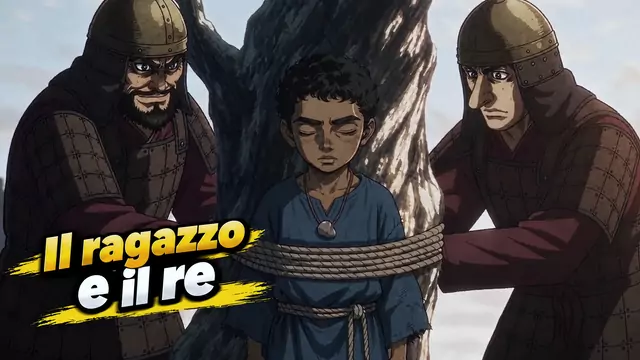 In riproduzione7:32Hadith in animeIl ragazzo e il re
 7:17Hadith in animeJurayj e l'invocazione di sua madre
 3:30Storie del CoranoLa storia di Gog e Magog
 2:28Hadith in animeIl hadith di Jibril
 3:49Racconti islamiciIl re e il ministro riconoscente
 1:47Hadith in animeL'uomo che uccise 99 persone
 2:11Hadith in animeI tre uomini intrappolati nella caverna
 2:04Hadith in animeIl lebbroso, il calvo e il cieco
 3:54Storie del CoranoIl Giorno del Giudizio
 17:11Storie del CoranoLa storia del profeta Yusuf (pace su di lui)
 1:31Hadith in animeL'uomo che prese in prestito 1.000 dinar