 Italiano
 English
 Español
 Русский
 中文
中文 Türkçe
 اردو
اردو Français
 Deutsch
Hadith in anime
Il lebbroso, il calvo e il cieco
Fonte e autenticità: Sahih al-Bukhari 3464Sahih (authentic)
- Raccolta
- Sahih al-Bukhari
- Narrazione
- Sahih al-Bukhari 3464Riferimento nel libro: Book 60 (Prophets), Hadith 131
- Valutazione
- Sahih (authentic)HadeethEnc, Al-Durar al-Saniyyah
- Riportato anche in
- Sahih Muslim 2964
Traduzione: Qabas
Apri su sunnah.comTre uomini ricevono ciascuno ciò che desideravano, e ognuno viene poi messo alla prova su come ricorda da dove gli è venuto.
Sottotitoli in 9 lingue: scegli la tua con il pulsante CC sul video. Per guardare non serve un account.
Lo hadith
Traduzione: Qabas · Sahih al-Bukhari 3464
Traduzione inglese verificata
Narrated Abu Huraira: that he heard Allah's Messenger (ﷺ) saying, "Allah willed to test three Israelis who were a Leper, a blind man and a bald-headed man. So, he sent them an angel who came to the leper and said, 'What thing do you like most?' He replied, 'Good color and good skin, for the people have a strong aversion to me.' The angel touched him and his illness was cured, and he was given a good color and beautiful skin. The angel asked him, 'What kind of property do you like best?' He replied, 'Camels (or cows).' (The narrator is in doubt, for either the leper or the bald-headed man demanded camels and the other demanded cows). So he (i.e. the leper) was given a pregnant she-camel, and the angel said (to him), 'May Allah bless you in it.' The angel then went to the bald-headed man and said, 'What thing do you like most?' He said, 'I like good hair and wish to be cured of this disease, for the people feel repulsion for me.' The angel touched him and his illness was cured, and he was given good hair. The angel asked (him), 'What kind of property do you like best?' He replied, 'Cows,' The angel gave him a pregnant cow and said, 'May Allah bless you in it.' The angel went to the blind man and asked, 'What thing do you like best?' He said, '(I like) that Allah may restore my eye-sight to me so that I may see the people.' The angel touched his eyes and Allah gave him back his eye-sight. The angel asked him, 'What kind of property do you like best?' He replied, 'Sheep.' The angel gave him a pregnant sheep. Afterwards, all the three pregnant animals gave birth to young ones, and multiplied and brought forth so much that one of the (three) men had a herd of camels filling a valley, and one had a herd of cows filling a valley, and one had a flock of sheep filling a valley. Then the angel, disguised in the shape and appearance of a leper, went to the leper and said, I am a poor man, who has lost all means of livelihood while on a journey. So none will satisfy my need except Allah and then you. In the Name of Him Who has given you such nice color and beautiful skin, and so much property, I ask you to give me a camel so that I may reach my destination. The man replied, 'I have many obligations (so I cannot give you).' The angel said, 'I think I know you; were you not a leper to whom the people had a strong aversion? Weren't you a poor man, and then Allah gave you (all this property).' He replied, '(This is all wrong), I got this property through inheritance from my fore-fathers.' The angel said, 'If you are telling a lie, then let Allah make you as you were before. ' Then the angel, disguised in the shape and appearance of a bald man, went to the bald man and said to him the same as he told the first one, and he too answered the same as the first one did. The angel said, 'If you are telling a lie, then let Allah make you as you were before.' The angel, disguised in the shape of a blind man, went to the blind man and said, 'I am a poor man and a traveler, whose means of livelihood have been exhausted while on a journey. I have nobody to help me except Allah, and after Him, you yourself. I ask you in the Name of Him Who has given you back your eye-sight to give me a sheep, so that with its help, I may complete my journey.' The man said, 'No doubt, I was blind and Allah gave me back my eye-sight; I was poor and Allah made me rich; so take anything you wish from my property. By Allah, I will not stop you for taking anything (you need) of my property which you may take for Allah's sake.' The angel replied, 'Keep your property with you. You (i.e the three men) have been tested, and Allah is pleased with you and is angry with your two companions."
English translation by Dr. M. Muhsin Khan, as published on Sunnah.com.
Fonte e autenticità
- Narrazione
- Sahih al-Bukhari 3464 (Riferimento nel libro: Book 60 (Prophets), Hadith 131)
- Riportato anche in
Sahih Muslim 2964 (Book 55 (The Book of Zuhd and Softening of Hearts), Hadith 15)The same story from Abu Hurayrah with slight differences in wording.
- Valutazione
Sahih (authentic)
- Riportato sia da al-Bukhari sia da Muslim (muttafaqun 'alayh). HadeethEnc lo classifica come «hadith autentico».[3]
- Al-Durar al-Saniyyah riporta il giudizio di al-Bukhari sulla sua narrazione (n. 3464) come sahih, e osserva che Muslim (2964) l'ha riportata con una lieve differenza di formulazione.[5]
Fonti
- [1] Sahih al-Bukhari 3464, Prophets, Sunnah.com (consultato il 2026-10-15)Arabic text and English translation (Dr. M. Muhsin Khan).
- [2] Sahih Muslim 2964, The Book of Zuhd and Softening of Hearts, Sunnah.com (consultato il 2026-10-15)Arabic text and English translation (Abdul Hamid Siddiqui).
- [3] HadeethEnc, hadith 5926 (English), Encyclopedia of Translated Prophetic Hadiths (consultato il 2026-10-15)Explanation and grading.
- [4] HadeethEnc, hadith 5926 (Arabic), benefits of the hadith, Encyclopedia of Translated Prophetic Hadiths (consultato il 2026-10-15)Benefits translated from Arabic by Qabas Academy.
- [5] Al-Durar al-Saniyyah, explanation of Sahih al-Bukhari 3464, Al-Durar al-Saniyyah (consultato il 2026-10-15)Arabic explanation, summarised and translated by Qabas Academy.
- [6] Riyad as-Salihin 65, Chapter: Watchfulness (al-Nawawi), Sunnah.com (consultato il 2026-10-15)
- [7] Quran 21:35, Saheeh International translation, Quran.com (consultato il 2026-10-15)
- [8] Ibn Hajar al-Asqalani, Fath al-Bari, vol. 6, pp. 579-581 (Book of the Prophets, hadith of the leper, the blind man and the bald man, commentary on Sahih al-Bukhari 3464), Islamweb.net library (consultato il 2026-10-16)Arabic, summarised and translated by Qabas Academy.Pagine consultate: pp. 579-581
- [9] Al-Nawawi, Sharh Sahih Muslim (al-Minhaj), vol. 18, pp. 398-399 (Book of Zuhd and Softening of Hearts), Islamweb.net library (consultato il 2026-10-16)Arabic, summarised and translated by Qabas Academy.Pagine consultate: pp. 398-399
- [10] Muhammad ibn Salih al-Uthaymeen, Sharh Riyad as-Salihin, vol. 1, pp. 498-507 (Chapter of Watchfulness, hadith 65), Al-Maktaba al-Shamila (shamela.ws), Dar al-Watan edition, Riyadh 1426 AH, page numbers as printed (consultato il 2026-10-16)Read on Shamela because binothaimeen.net does not publish this text online: its reading library offers only the index of the volume (official PDF, 10 pages), whose page numbers match this edition. Arabic, summarised and translated by Qabas Academy.Pagine consultate: p. 498, p. 499, p. 500, p. 501, p. 502, p. 503, p. 504, p. 505, p. 506, p. 507
Spiegazione
- Al-Durar al-Saniyyah comincia osservando che il Profeta (pace e benedizioni di Allah su di lui) insegnava avvicinando i significati alle persone attraverso storie ed esempi.[5]
- Ibn 'Uthaymin (vol. 1, pp. 500-501) spiega come trattare i racconti sui Figli di Israele. Ciò che viene nel Corano o nella Sunna autentica, come questo hadith, è vero senza dubbio. Ciò che viene dai loro stessi dotti si respinge se la nostra legge mostra che è falso, si accetta se la nostra legge lo conferma, e altrimenti non lo si crede né lo si smentisce, anche se non c'è nulla di male a raccontarlo per incoraggiare il bene o mettere in guardia dal male.[10]
- L'espressione araba, bada lillahi an yabtaliyahum, parla letteralmente della prova come di qualcosa che divenne manifesto ad Allah. Al-Durar al-Saniyyah spiega che significa che la prova era già nella conoscenza di Allah ed Egli volle renderla manifesta, non che qualcosa Gli divenne chiaro dopo essere stato nascosto, cosa impossibile per Allah.[5]
- HadeethEnc spiega che i tre erano poveri, ciascuno con un'afflizione fisica, e che Allah volle mettere alla prova la loro fede e la loro gratitudine, perciò mandò loro un angelo in forma umana.[3]
- Ibn Hajar (vol. 6, p. 579), la cui spiegazione è seguita da al-Durar al-Saniyyah, aggiunge che la narrazione di Muslim usa un verbo diverso (arada, volere), e che la lettura più corretta è che Allah decretò di metterli alla prova, mai un cambiamento in ciò che Egli sapeva.[8]
- Ognuno ricevette ciò che desiderava: una bella pelle, bei capelli, la vista restituita, e poi una cammella gravida, una mucca gravida e una pecora con il suo piccolo. Il narratore non era sicuro se il lebbroso avesse chiesto cammelli o mucche; HadeethEnc considera i cammelli «più probabili», poiché gli fu data una cammella. Al-Durar al-Saniyyah nota che una cammella gravida da dieci mesi era tra i tipi di cammello più preziosi.[1][3][5]
- Ibn 'Uthaymin (vol. 1, p. 502) ne spiega lo scopo: Allah mette alla prova il servo con la difficoltà per vedere se è paziente o insofferente, e con l'agio per vedere se è riconoscente o avaro.[10]
- Poi venne la prova. L'angelo tornò da ciascuno con l'aspetto e le sembianze che egli aveva un tempo, come un viaggiatore rimasto senza mezzi. Il lebbroso e il calvo rifiutarono e sostennero di aver ereditato le loro ricchezze. HadeethEnc lo descrive come rinnegamento dei favori di Allah, «spinto dalla sua avarizia».[1][3]
- Il cieco riconobbe da dove veniva ogni cosa: era stato cieco e Allah gli aveva restituito la vista, era stato povero e Allah lo aveva reso ricco. Disse al viaggiatore di prendere tutto ciò che voleva. L'angelo gli disse che erano stati messi alla prova, che Allah era soddisfatto di lui e scontento dei suoi due compagni.[1]
- Ibn 'Uthaymin (vol. 1, p. 503) fa notare un particolare: il cieco chiese soltanto la vista per vedere la gente, e scelse le pecore piuttosto che i cammelli o le mucche, segni del suo distacco, mentre gli altri due chiesero più di quanto avessero bisogno.[10]
- HadeethEnc aggiunge che Allah li mise alla prova perché fossero ricompensati «in base a ciò che avete fatto, non in base alla Sua prescienza». L'Imam al-Nawawi ha collocato questo hadith nel capitolo sulla Vigilanza (al-Muraqaba) di Riyad as-Salihin (n. 65).[3][6]
- Ibn Hajar (vol. 6, p. 580) spiega che l'angelo venne da ciascuno proprio nell'aspetto che aveva prima, per rendere più forte la prova contro di lui, e riporta l'opinione di Ibn al-Tin secondo cui le parole del viaggiatore erano un modo indiretto di parlare, un'immagine pensata per risvegliare l'ascoltatore al proprio passato.[8]
- Che cosa accadde poi ai due? Ibn Hajar (vol. 6, p. 581) dice che il senso apparente è che toccò loro ciò che l'angelo aveva detto, e Ibn 'Uthaymin (vol. 1, p. 505) che a quanto pare Allah esaudì la preghiera dell'angelo e li riportò alla loro povertà e alla loro malattia. Ibn Hajar nota anche che raccontare simili storie di persone del passato per trarne insegnamento è lecito e non è maldicenza, il che può spiegare perché non vengano nominati.[8][10]
- Sulla scusa del lebbroso di avere molti obblighi, Ibn 'Uthaymin (vol. 1, p. 504) commenta che a quanto pare non ne adempiva nessuno, poiché un viaggiatore povero rimasto senza mezzi è tra coloro che più meritano aiuto.[10]
Lezioni e benefici
- La gratitudine per le grazie che Allah concede nei beni è un obbligo, e lo è anche dare ad Allah ciò che Gli spetta di essi.[4]
- Allah mette alla prova i Suoi servi con le grazie, come Egli dice: «Vi sottoporremo alla tentazione con il male e con il bene e poi a Noi sarete ricondotti» (Corano 21:35, traduzione di Hamza Roberto Piccardo).[4][7]
- Attribuire una grazia ad Allah è gratitudine per essa e motivo perché resti; attribuirla a chiunque altro è ingratitudine e motivo perché vada perduta.[4]
- La gratitudine è causa del permanere e del crescere delle grazie, come spiega Ibn 'Uthaymin (vol. 1, pp. 505 e 507), citando il Corano 14:7; riconoscere il favore di Allah e versare ciò che è dovuto sui propri beni conserva in essi la benedizione.[10]
- È corretto dire billahi thumma bik (per Allah, poi per te), unendo le due cose con thumma (poi) e non con wa (e), in un'espressione come questa.[4]
- Un monito contro l'ingratitudine e l'avarizia, e un incoraggiamento a fare l'elemosina e a essere gentili con i deboli e aiutarli.[5][4]
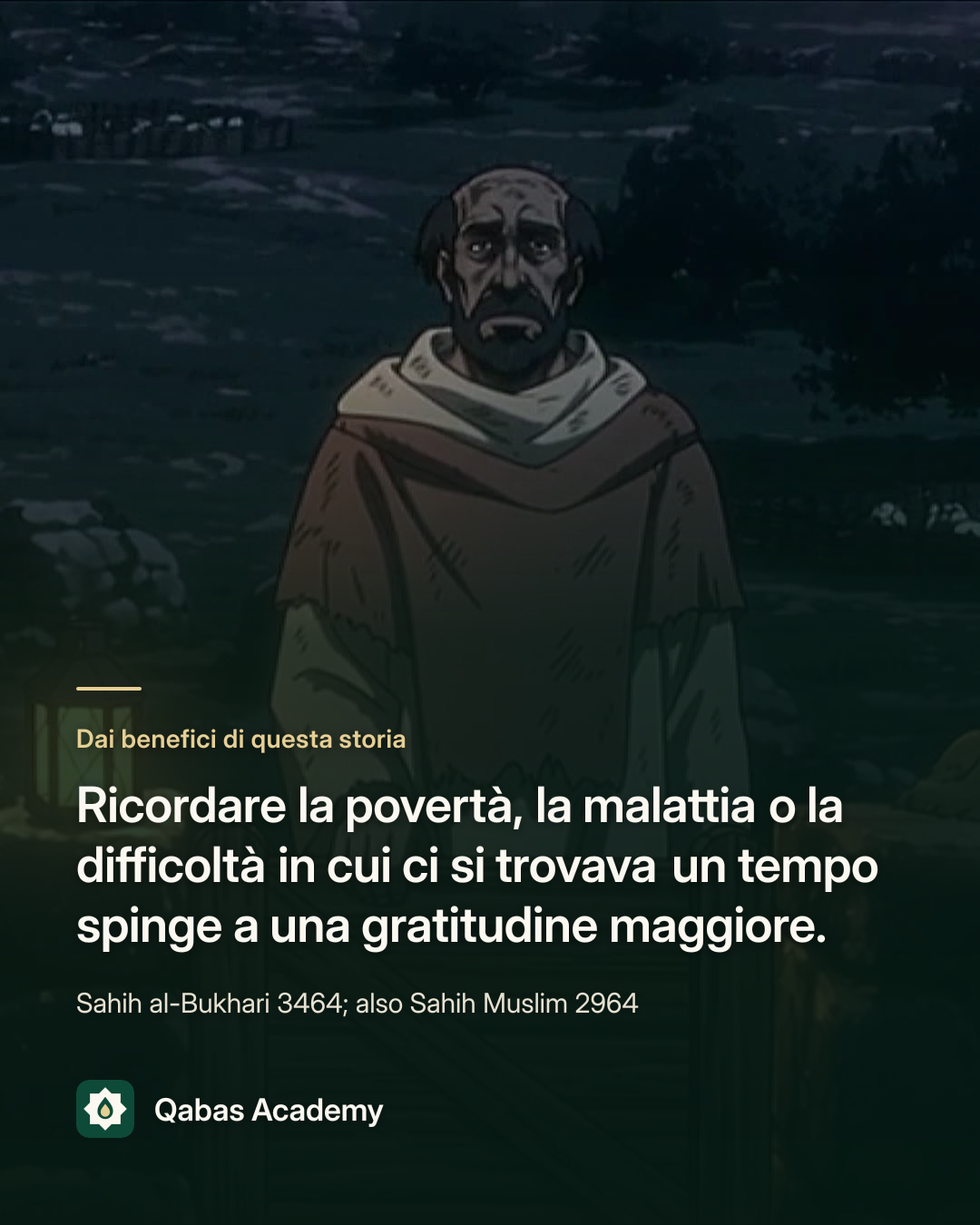
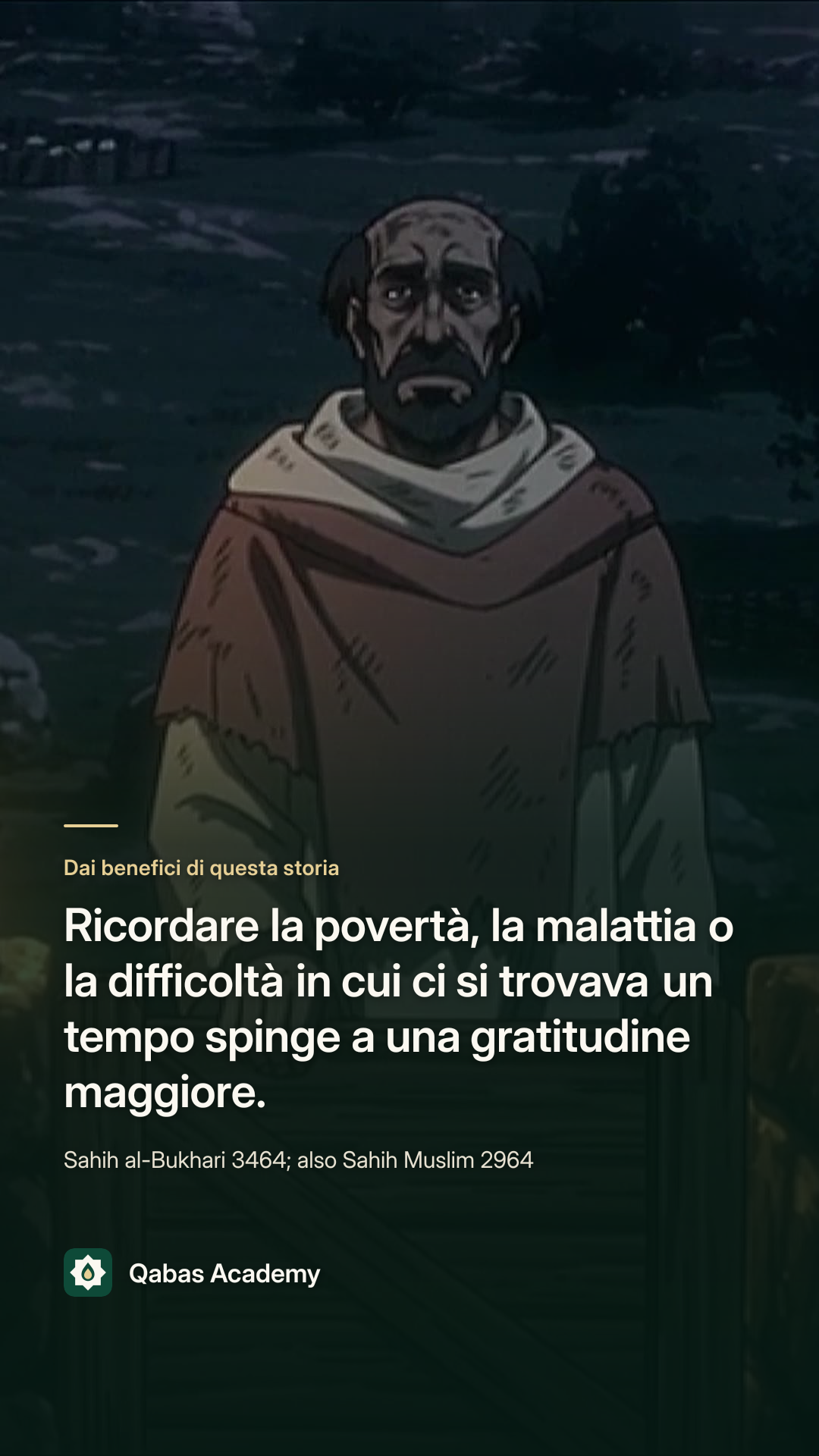
- Ricordare la povertà, la malattia o la difficoltà in cui ci si trovava un tempo spinge a una gratitudine maggiore.[5]
- Al-Nawawi (vol. 18, p. 399) ne trae l'incoraggiamento a essere gentili con i deboli, a onorarli e a dare loro ciò che chiedono quando è possibile, e il monito a non spezzare loro il cuore né guardarli dall'alto in basso; e che si deve parlare delle grazie di Allah, non negarle.[9]
- La pazienza nell'afflizione può essere per chi è afflitto migliore della sua scomparsa.[5]
- Ibn Hajar (vol. 6, p. 581) nota che qui l'avarizia è condannata perché spinse i due uomini a mentire e a negare la grazia di Allah.[8]
- Le persone differiscono molto nel modo in cui ringraziano Allah e in cui giovano agli altri.[10]
Domande per riflettere
Queste domande sono scritte da Qabas Academy per aiutarti a riflettere. Non fanno parte dello hadith né del suo commento.
- Quale grazia tratti ormai come se l'avessi sempre avuta?
- I due uomini dissero «l'ho ereditato». Dove anche noi spieghiamo i doni di Allah come merito nostro?
- L'angelo venne con l'aspetto che avevano un tempo. Chi, intorno a te, somiglia alla persona che eri?
- La risposta del cieco ti verrebbe facile? Che cosa te la renderebbe più facile?
Card di riflessione
Una card con una riflessione tratta da questo episodio e la sua fonte, pronta da condividere.
Altri episodi
 1:47Hadith in animeL'uomo che uccise 99 persone
 2:11Hadith in animeI tre uomini intrappolati nella caverna
 In riproduzione2:04Hadith in animeIl lebbroso, il calvo e il cieco
 3:54Storie del CoranoIl Giorno del Giudizio
 17:11Storie del CoranoLa storia del profeta Yusuf (pace su di lui)
 1:31Hadith in animeL'uomo che prese in prestito 1.000 dinar