 中文
中文 English
 Español
 Русский
 Türkçe
 اردو
اردو Italiano
 Français
 Deutsch
圣训动画
麻风病人、秃头人和盲人
出处与可靠性: Sahih al-Bukhari 3464Sahih (authentic)
- 辑录
- Sahih al-Bukhari
- 传述
- Sahih al-Bukhari 3464书内编号: Book 60 (Prophets), Hadith 131
- 评定
- Sahih (authentic)HadeethEnc, Al-Durar al-Saniyyah
译文:Qabas
在 sunnah.com 上打开三个人各自得到了渴望的东西,后来每个人都受到考验:是否还记得这一切从何而来。
字幕提供9种语言,请点视频上的 CC 按钮选择。观看无需注册账户。
圣训原文
译文:Qabas · Sahih al-Bukhari 3464
经核实的英文译本
Narrated Abu Huraira: that he heard Allah's Messenger (ﷺ) saying, "Allah willed to test three Israelis who were a Leper, a blind man and a bald-headed man. So, he sent them an angel who came to the leper and said, 'What thing do you like most?' He replied, 'Good color and good skin, for the people have a strong aversion to me.' The angel touched him and his illness was cured, and he was given a good color and beautiful skin. The angel asked him, 'What kind of property do you like best?' He replied, 'Camels (or cows).' (The narrator is in doubt, for either the leper or the bald-headed man demanded camels and the other demanded cows). So he (i.e. the leper) was given a pregnant she-camel, and the angel said (to him), 'May Allah bless you in it.' The angel then went to the bald-headed man and said, 'What thing do you like most?' He said, 'I like good hair and wish to be cured of this disease, for the people feel repulsion for me.' The angel touched him and his illness was cured, and he was given good hair. The angel asked (him), 'What kind of property do you like best?' He replied, 'Cows,' The angel gave him a pregnant cow and said, 'May Allah bless you in it.' The angel went to the blind man and asked, 'What thing do you like best?' He said, '(I like) that Allah may restore my eye-sight to me so that I may see the people.' The angel touched his eyes and Allah gave him back his eye-sight. The angel asked him, 'What kind of property do you like best?' He replied, 'Sheep.' The angel gave him a pregnant sheep. Afterwards, all the three pregnant animals gave birth to young ones, and multiplied and brought forth so much that one of the (three) men had a herd of camels filling a valley, and one had a herd of cows filling a valley, and one had a flock of sheep filling a valley. Then the angel, disguised in the shape and appearance of a leper, went to the leper and said, I am a poor man, who has lost all means of livelihood while on a journey. So none will satisfy my need except Allah and then you. In the Name of Him Who has given you such nice color and beautiful skin, and so much property, I ask you to give me a camel so that I may reach my destination. The man replied, 'I have many obligations (so I cannot give you).' The angel said, 'I think I know you; were you not a leper to whom the people had a strong aversion? Weren't you a poor man, and then Allah gave you (all this property).' He replied, '(This is all wrong), I got this property through inheritance from my fore-fathers.' The angel said, 'If you are telling a lie, then let Allah make you as you were before. ' Then the angel, disguised in the shape and appearance of a bald man, went to the bald man and said to him the same as he told the first one, and he too answered the same as the first one did. The angel said, 'If you are telling a lie, then let Allah make you as you were before.' The angel, disguised in the shape of a blind man, went to the blind man and said, 'I am a poor man and a traveler, whose means of livelihood have been exhausted while on a journey. I have nobody to help me except Allah, and after Him, you yourself. I ask you in the Name of Him Who has given you back your eye-sight to give me a sheep, so that with its help, I may complete my journey.' The man said, 'No doubt, I was blind and Allah gave me back my eye-sight; I was poor and Allah made me rich; so take anything you wish from my property. By Allah, I will not stop you for taking anything (you need) of my property which you may take for Allah's sake.' The angel replied, 'Keep your property with you. You (i.e the three men) have been tested, and Allah is pleased with you and is angry with your two companions."
English translation by Dr. M. Muhsin Khan, as published on Sunnah.com.
出处与可靠性
- 传述
- Sahih al-Bukhari 3464 (书内编号: Book 60 (Prophets), Hadith 131)
- 另见于
Sahih Muslim 2964 (Book 55 (The Book of Zuhd and Softening of Hearts), Hadith 15)The same story from Abu Hurayrah with slight differences in wording.
- 评定
Sahih (authentic)
参考资料
- [1] Sahih al-Bukhari 3464, Prophets, Sunnah.com (访问于 2026-10-15)Arabic text and English translation (Dr. M. Muhsin Khan).
- [2] Sahih Muslim 2964, The Book of Zuhd and Softening of Hearts, Sunnah.com (访问于 2026-10-15)Arabic text and English translation (Abdul Hamid Siddiqui).
- [3] HadeethEnc, hadith 5926 (English), Encyclopedia of Translated Prophetic Hadiths (访问于 2026-10-15)Explanation and grading.
- [4] HadeethEnc, hadith 5926 (Arabic), benefits of the hadith, Encyclopedia of Translated Prophetic Hadiths (访问于 2026-10-15)Benefits translated from Arabic by Qabas Academy.
- [5] Al-Durar al-Saniyyah, explanation of Sahih al-Bukhari 3464, Al-Durar al-Saniyyah (访问于 2026-10-15)Arabic explanation, summarised and translated by Qabas Academy.
- [6] Riyad as-Salihin 65, Chapter: Watchfulness (al-Nawawi), Sunnah.com (访问于 2026-10-15)
- [7] Quran 21:35, Saheeh International translation, Quran.com (访问于 2026-10-15)
- [8] Ibn Hajar al-Asqalani, Fath al-Bari, vol. 6, pp. 579-581 (Book of the Prophets, hadith of the leper, the blind man and the bald man, commentary on Sahih al-Bukhari 3464), Islamweb.net library (访问于 2026-10-16)Arabic, summarised and translated by Qabas Academy.查阅的页面: pp. 579-581
- [9] Al-Nawawi, Sharh Sahih Muslim (al-Minhaj), vol. 18, pp. 398-399 (Book of Zuhd and Softening of Hearts), Islamweb.net library (访问于 2026-10-16)Arabic, summarised and translated by Qabas Academy.查阅的页面: pp. 398-399
- [10] Muhammad ibn Salih al-Uthaymeen, Sharh Riyad as-Salihin, vol. 1, pp. 498-507 (Chapter of Watchfulness, hadith 65), Al-Maktaba al-Shamila (shamela.ws), Dar al-Watan edition, Riyadh 1426 AH, page numbers as printed (访问于 2026-10-16)Read on Shamela because binothaimeen.net does not publish this text online: its reading library offers only the index of the volume (official PDF, 10 pages), whose page numbers match this edition. Arabic, summarised and translated by Qabas Academy.查阅的页面: p. 498, p. 499, p. 500, p. 501, p. 502, p. 503, p. 504, p. 505, p. 506, p. 507
讲解
- 《杜拉尔·萨尼耶》开篇指出,先知(愿主福安之)教导人们时,常借助故事和比喻使意义贴近人心。[5]
- 伊本·欧赛敏(第1卷,第500-501页)解释了应如何对待有关以色列后裔的传闻。凡见于《古兰经》或健全的圣行的,如这段圣训,毫无疑问是真实的。凡出自他们自己学者的,若我们的教法表明其为虚假,则予以拒绝;若我们的教法证实了它,则予以接受;否则既不相信也不否认,不过为了劝善或警恶而讲述它并无妨碍。[10]
- 阿拉伯语原文 bada lillahi an yabtaliyahum,字面上把这场考验说成是对安拉“显现”出来的事。《杜拉尔·萨尼耶》解释说,它的意思是这场考验早已在安拉的知识之中,祂意欲使之显现;而不是说某事原本隐藏、后来才对祂显现,这对安拉来说是不可能的。[5]
- HadeethEnc 解释说,这三个人都很贫穷,各有一种身体上的病痛;安拉要考验他们的信仰和感恩之心,于是派了一位天使以人的形象到他们那里。[3]
- 伊本·哈杰尔(第6卷,第579页)——《杜拉尔·萨尼耶》的解释沿用了他的说法——补充说,穆斯林的传述用的是另一个动词(阿拉达,意为“意欲”),最妥当的理解是安拉定然要考验他们,而绝非祂的知识有所改变。[8]
- 每个人都得到了自己渴望的东西:好皮肤、好头发、恢复的视力,随后又各得一头怀孕的母驼、一头怀孕的母牛和一只带崽的母羊。传述人不确定麻风病人要的是骆驼还是牛;HadeethEnc 认为骆驼“最有可能”,因为他得到的是一头母驼。《杜拉尔·萨尼耶》指出,怀孕十个月的母驼是骆驼中最珍贵的一类。[1][3][5]
- 伊本·欧赛敏(第1卷,第502页)解释了其中的用意:安拉以艰难考验仆人,看他是忍耐还是怨恨;又以安逸考验他,看他是感恩还是吝啬。[10]
- 接着考验来临。天使以每个人从前的样子和模样,扮作一个落难的旅人,再次来到他们面前。麻风病人和秃头人拒绝了他,并声称自己的财富是继承来的。HadeethEnc 把这形容为否认安拉的恩典,“出于他的吝啬”。[1][3]
- 盲人承认一切从何而来:他曾经失明,是安拉使他复明;他曾经贫穷,是安拉使他富足。他让旅人想拿什么就拿什么。天使告诉他,他们都受到了考验,安拉喜悦他,而恼怒他的两个同伴。[1]
- 伊本·欧赛敏(第1卷,第503页)指出了一个细节:盲人只求能看见人们的视力,并且选择了羊而不是骆驼或牛,这显示了他对今世的淡泊;而另外两人所求的超过了他们的需要。[10]
- HadeethEnc 补充说,安拉考验他们,是为了让他们“根据你们所做的,而不是根据祂的预知”得到回报。伊玛目奈瓦威将这段圣训收录在《正义者园圃》的“警觉(穆拉格白)”一章(第65段)。[3][6]
- 伊本·哈杰尔(第6卷,第580页)解释说,天使以每个人从前的样子来到他面前,是为了让针对他的证据更加有力;他还记述了伊本·廷的看法:旅人的话是一种间接的说法,是一幅意在唤醒听者回想自己过去的画面。[8]
- 后来那两个人怎样了?伊本·哈杰尔(第6卷,第581页)说,表面的意思是事情正如天使所说的那样降临到他们身上;伊本·欧赛敏(第1卷,第505页)则说,看来安拉应答了天使的祈祷,使他们回到了贫穷和病痛之中。伊本·哈杰尔还指出,讲述前人的这类故事以汲取教训是允许的,并不算背谈,这或许就是他们没有被点名的原因。[8][10]
- 对于麻风病人推说自己负担很多的借口,伊本·欧赛敏(第1卷,第504页)评论说,看来他一项也没有履行,因为一个困顿落难的穷苦旅人,正是最应当得到帮助的人之一。[10]
教益与收获
- 为安拉在财富上的恩典而感恩是一项义务,从中交出安拉应得的那一份也是义务。[4]
- 安拉以恩典考验祂的仆人,正如祂所说:“我以祸福考验你们,你们只被召归我。”(《古兰经》21:35,马坚译)[4][7]
- 把恩典归于安拉,就是对它的感恩,也是它得以长存的原因;把它归于别人,就是忘恩负义,也是它丧失的原因。[4]
- 感恩是恩典得以长存和增长的原因,伊本·欧赛敏(第1卷,第505页和第507页)援引《古兰经》14:7 作了这样的解释;承认安拉的恩惠、交出财富中应交的那一份,能让财富中的福分长存。[10]
- 在类似的表达中,说 billahi thumma bik(凭安拉,然后凭你)是正确的,即用 thumma(然后)而不是 wa(和)把两者连接起来。[4]
- 这是对忘恩负义和吝啬的警告,也是对施舍、善待和帮助弱者的鼓励。[5][4]
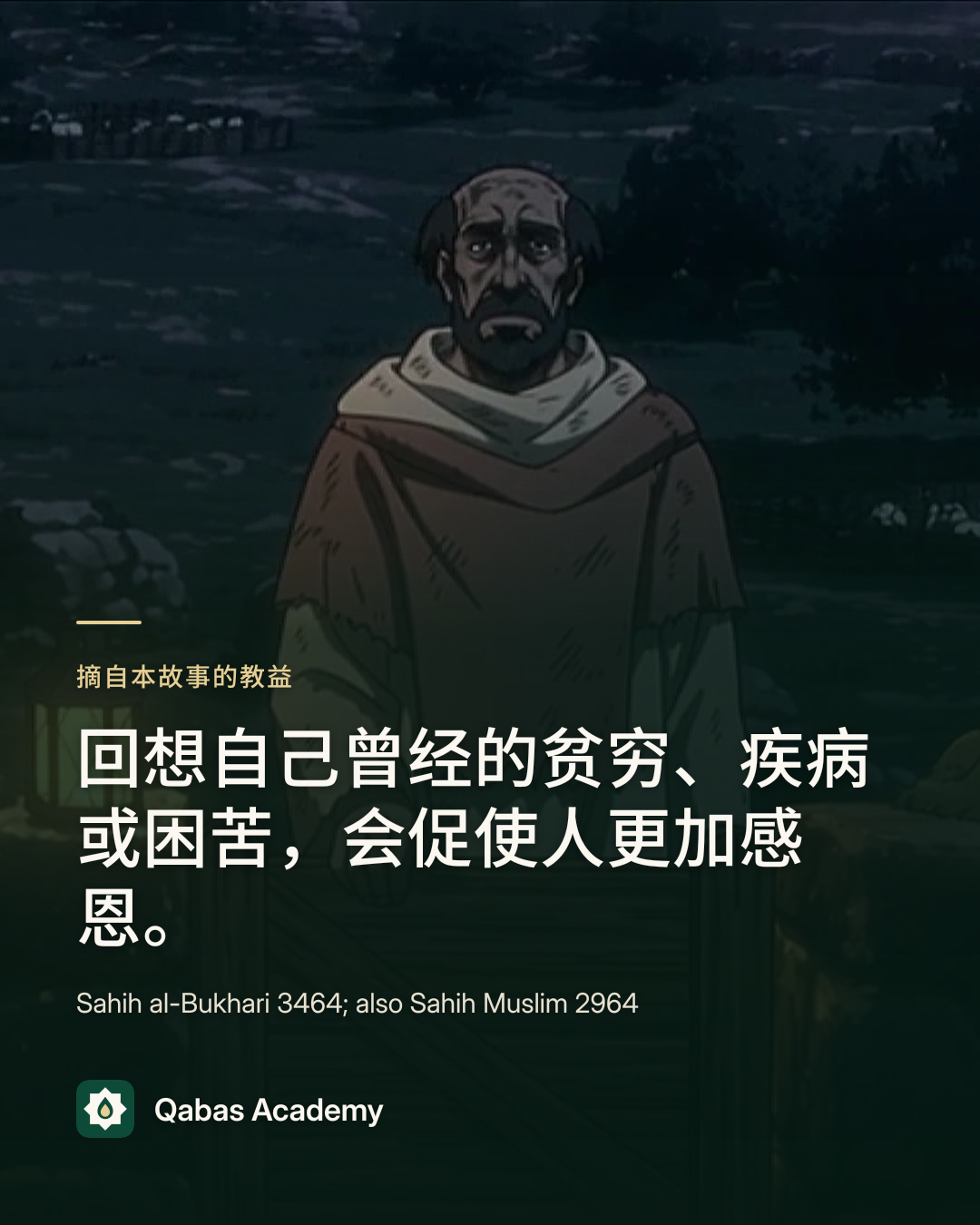
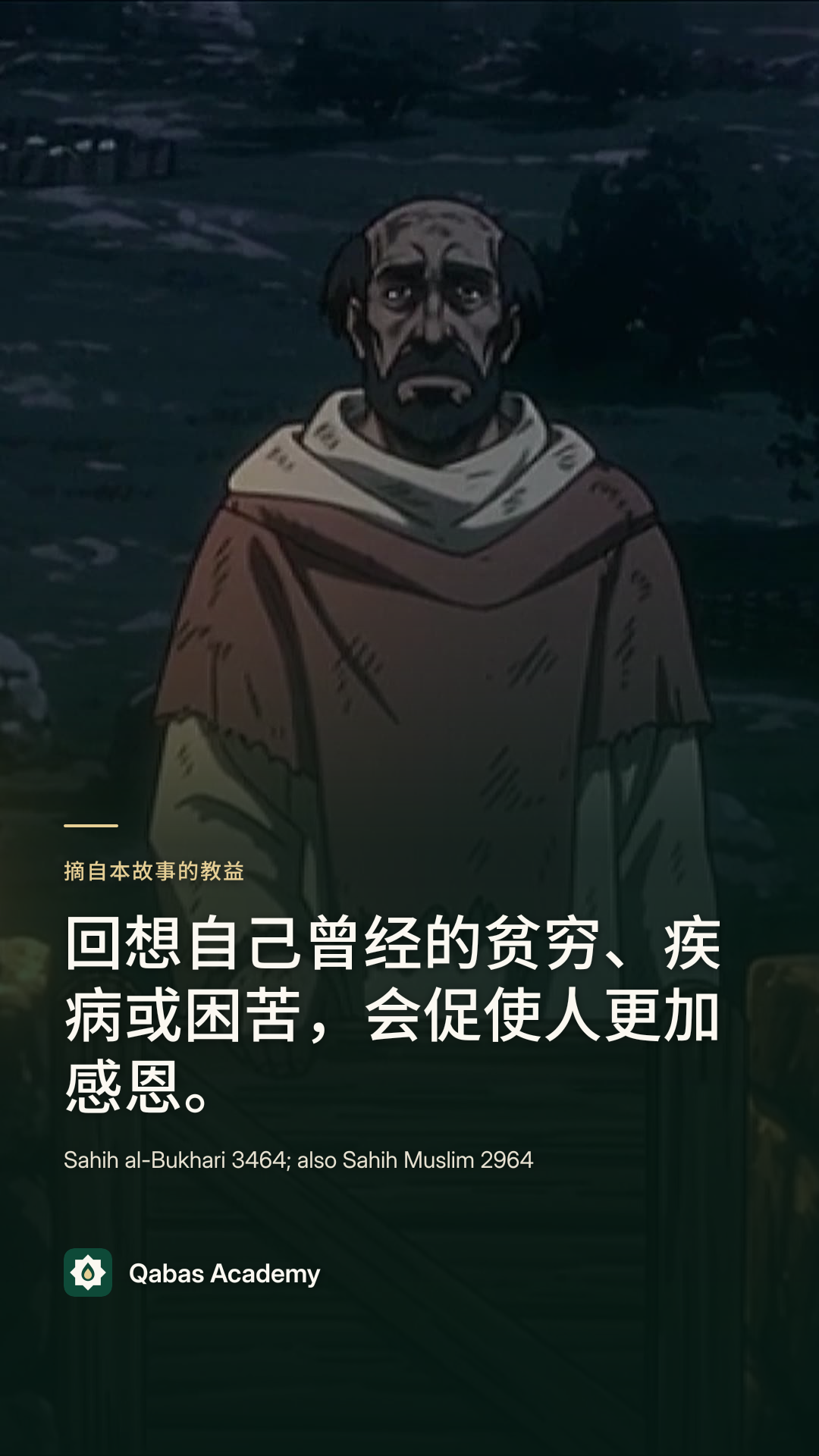
- 回想自己曾经的贫穷、疾病或困苦,会促使人更加感恩。[5]
- 奈瓦威(第18卷,第399页)从中得出:要善待弱者、尊重他们,并在可能时满足他们的请求;要警惕伤他们的心或轻视他们;还应当讲述安拉的恩典,而不是否认它。[9]
- 对受苦的人来说,在苦难中忍耐有时比苦难被解除更好。[5]
- 伊本·哈杰尔(第6卷,第581页)指出,这里之所以谴责吝啬,是因为它驱使那两个人撒谎,并否认了安拉的恩典。[8]
- 人们在感谢安拉和惠及他人这两方面相差甚远。[10]
思考题
这些问题由 Qabas Academy 撰写,帮助你思考。它们不是圣训或其注释的一部分。
- 有哪一种恩典,你如今对待它的方式,就好像它一直都属于你?
- 那两个人说“这是我继承来的”。我们在哪些地方把安拉的恩赐说成是自己的成就?
- 天使来时的样子就像他们从前的自己。在你身边,谁像曾经的你?
- 盲人的回答对你来说会不会脱口而出?什么能让它变得更容易?
感悟卡片
一张卡片,载有本集的一条感悟及其出处,方便分享。