 Español
 English
 Русский
 中文
中文 Türkçe
 اردو
اردو Italiano
 Français
 Deutsch
Hadices en anime
El leproso, el calvo y el ciego
Fuente y autenticidad: Sahih al-Bukhari 3464Sahih (authentic)
- Colección
- Sahih al-Bukhari
- Narración
- Sahih al-Bukhari 3464Referencia en el libro: Book 60 (Prophets), Hadith 131
- Calificación
- Sahih (authentic)HadeethEnc, Al-Durar al-Saniyyah
- También recogido en
- Sahih Muslim 2964
Traducción: Qabas
Abrir en sunnah.comA tres hombres se les concede lo que tanto anhelaban, y más tarde cada uno es puesto a prueba en cómo recuerda de dónde le vino.
Subtítulos en 9 idiomas: elige el tuyo con el botón CC del vídeo. Para verlo no hace falta cuenta.
El hadiz
Traducción: Qabas · Sahih al-Bukhari 3464
Traducción inglesa verificada
Narrated Abu Huraira: that he heard Allah's Messenger (ﷺ) saying, "Allah willed to test three Israelis who were a Leper, a blind man and a bald-headed man. So, he sent them an angel who came to the leper and said, 'What thing do you like most?' He replied, 'Good color and good skin, for the people have a strong aversion to me.' The angel touched him and his illness was cured, and he was given a good color and beautiful skin. The angel asked him, 'What kind of property do you like best?' He replied, 'Camels (or cows).' (The narrator is in doubt, for either the leper or the bald-headed man demanded camels and the other demanded cows). So he (i.e. the leper) was given a pregnant she-camel, and the angel said (to him), 'May Allah bless you in it.' The angel then went to the bald-headed man and said, 'What thing do you like most?' He said, 'I like good hair and wish to be cured of this disease, for the people feel repulsion for me.' The angel touched him and his illness was cured, and he was given good hair. The angel asked (him), 'What kind of property do you like best?' He replied, 'Cows,' The angel gave him a pregnant cow and said, 'May Allah bless you in it.' The angel went to the blind man and asked, 'What thing do you like best?' He said, '(I like) that Allah may restore my eye-sight to me so that I may see the people.' The angel touched his eyes and Allah gave him back his eye-sight. The angel asked him, 'What kind of property do you like best?' He replied, 'Sheep.' The angel gave him a pregnant sheep. Afterwards, all the three pregnant animals gave birth to young ones, and multiplied and brought forth so much that one of the (three) men had a herd of camels filling a valley, and one had a herd of cows filling a valley, and one had a flock of sheep filling a valley. Then the angel, disguised in the shape and appearance of a leper, went to the leper and said, I am a poor man, who has lost all means of livelihood while on a journey. So none will satisfy my need except Allah and then you. In the Name of Him Who has given you such nice color and beautiful skin, and so much property, I ask you to give me a camel so that I may reach my destination. The man replied, 'I have many obligations (so I cannot give you).' The angel said, 'I think I know you; were you not a leper to whom the people had a strong aversion? Weren't you a poor man, and then Allah gave you (all this property).' He replied, '(This is all wrong), I got this property through inheritance from my fore-fathers.' The angel said, 'If you are telling a lie, then let Allah make you as you were before. ' Then the angel, disguised in the shape and appearance of a bald man, went to the bald man and said to him the same as he told the first one, and he too answered the same as the first one did. The angel said, 'If you are telling a lie, then let Allah make you as you were before.' The angel, disguised in the shape of a blind man, went to the blind man and said, 'I am a poor man and a traveler, whose means of livelihood have been exhausted while on a journey. I have nobody to help me except Allah, and after Him, you yourself. I ask you in the Name of Him Who has given you back your eye-sight to give me a sheep, so that with its help, I may complete my journey.' The man said, 'No doubt, I was blind and Allah gave me back my eye-sight; I was poor and Allah made me rich; so take anything you wish from my property. By Allah, I will not stop you for taking anything (you need) of my property which you may take for Allah's sake.' The angel replied, 'Keep your property with you. You (i.e the three men) have been tested, and Allah is pleased with you and is angry with your two companions."
English translation by Dr. M. Muhsin Khan, as published on Sunnah.com.
Fuente y autenticidad
- Narración
- Sahih al-Bukhari 3464 (Referencia en el libro: Book 60 (Prophets), Hadith 131)
- También recogido en
Sahih Muslim 2964 (Book 55 (The Book of Zuhd and Softening of Hearts), Hadith 15)The same story from Abu Hurayrah with slight differences in wording.
- Calificación
Sahih (authentic)
Fuentes
- [1] Sahih al-Bukhari 3464, Prophets, Sunnah.com (consultado el 2026-10-15)Arabic text and English translation (Dr. M. Muhsin Khan).
- [2] Sahih Muslim 2964, The Book of Zuhd and Softening of Hearts, Sunnah.com (consultado el 2026-10-15)Arabic text and English translation (Abdul Hamid Siddiqui).
- [3] HadeethEnc, hadith 5926 (English), Encyclopedia of Translated Prophetic Hadiths (consultado el 2026-10-15)Explanation and grading.
- [4] HadeethEnc, hadith 5926 (Arabic), benefits of the hadith, Encyclopedia of Translated Prophetic Hadiths (consultado el 2026-10-15)Benefits translated from Arabic by Qabas Academy.
- [5] Al-Durar al-Saniyyah, explanation of Sahih al-Bukhari 3464, Al-Durar al-Saniyyah (consultado el 2026-10-15)Arabic explanation, summarised and translated by Qabas Academy.
- [6] Riyad as-Salihin 65, Chapter: Watchfulness (al-Nawawi), Sunnah.com (consultado el 2026-10-15)
- [7] Quran 21:35, Saheeh International translation, Quran.com (consultado el 2026-10-15)
- [8] Ibn Hajar al-Asqalani, Fath al-Bari, vol. 6, pp. 579-581 (Book of the Prophets, hadith of the leper, the blind man and the bald man, commentary on Sahih al-Bukhari 3464), Islamweb.net library (consultado el 2026-10-16)Arabic, summarised and translated by Qabas Academy.Páginas consultadas: pp. 579-581
- [9] Al-Nawawi, Sharh Sahih Muslim (al-Minhaj), vol. 18, pp. 398-399 (Book of Zuhd and Softening of Hearts), Islamweb.net library (consultado el 2026-10-16)Arabic, summarised and translated by Qabas Academy.Páginas consultadas: pp. 398-399
- [10] Muhammad ibn Salih al-Uthaymeen, Sharh Riyad as-Salihin, vol. 1, pp. 498-507 (Chapter of Watchfulness, hadith 65), Al-Maktaba al-Shamila (shamela.ws), Dar al-Watan edition, Riyadh 1426 AH, page numbers as printed (consultado el 2026-10-16)Read on Shamela because binothaimeen.net does not publish this text online: its reading library offers only the index of the volume (official PDF, 10 pages), whose page numbers match this edition. Arabic, summarised and translated by Qabas Academy.Páginas consultadas: p. 498, p. 499, p. 500, p. 501, p. 502, p. 503, p. 504, p. 505, p. 506, p. 507
Explicación
- Al-Durar al-Saniyyah comienza señalando que el Profeta (la paz y las bendiciones de Allah sean con él) enseñaba acercando los significados a la gente por medio de historias y ejemplos.[5]
- Ibn Uthaymín (vol. 1, pp. 500-501) explica cómo tratar los relatos sobre los Hijos de Israel. Lo que aparece en el Corán o en la Sunna auténtica, como este hadiz, es verdad sin duda. Lo que procede de sus propios sabios se rechaza si nuestra ley muestra que es falso, se acepta si nuestra ley lo confirma, y en otro caso ni se cree ni se desmiente, aunque no hay inconveniente en contarlo para animar al bien o advertir contra el mal.[10]
- La expresión árabe, bada lillahi an yabtaliyahum, habla literalmente de la prueba como algo que se le hizo manifiesto a Allah. Al-Durar al-Saniyyah explica que significa que la prueba ya estaba en el conocimiento de Allah y que Él quiso hacerla manifiesta, no que algo se Le hiciera evidente después de haber estado oculto, lo cual es imposible para Allah.[5]
- HadeethEnc explica que los tres eran pobres, cada uno con una aflicción física, y que Allah quiso poner a prueba su fe y su gratitud, de modo que les envió un ángel en forma de hombre.[3]
- Ibn Hayar (vol. 6, p. 579), cuya explicación sigue Al-Durar al-Saniyyah, añade que la narración de Muslim usa otro verbo (arada, querer), y que la lectura más acertada es que Allah decretó ponerlos a prueba, nunca un cambio en lo que Él sabía.[8]
- Cada uno recibió lo que anhelaba: una piel sana, un cabello hermoso, la vista recobrada, y después una camella preñada, una vaca preñada y una oveja con cría. El narrador no estaba seguro de si el leproso pidió camellos o vacas; HadeethEnc considera que camellos es «lo más probable», ya que se le dio una camella. Al-Durar al-Saniyyah señala que una camella con diez meses de preñez estaba entre los tipos de camello más preciados.[1][3][5]
- Ibn Uthaymín (vol. 1, p. 502) explica el propósito: Allah prueba al siervo con la dificultad para ver si es paciente o se queja con resentimiento, y con la holgura para ver si es agradecido o tacaño.[10]
- Luego llegó la prueba. El ángel volvió a cada uno con la forma y el aspecto que él mismo solía tener, como un viajero desamparado. El leproso y el calvo se negaron y afirmaron que habían heredado su riqueza. HadeethEnc lo describe como una negación de los favores de Allah, «movida por su avaricia».[1][3]
- El ciego reconoció de dónde venía todo: había sido ciego y Allah le devolvió la vista, había sido pobre y Allah lo enriqueció. Le dijo al viajero que tomara lo que quisiera. El ángel le dijo que habían sido puestos a prueba, que Allah estaba complacido con él y disgustado con sus dos compañeros.[1]
- Ibn Uthaymín (vol. 1, p. 503) señala un detalle: el ciego pidió solo la vista para ver a la gente, y eligió ovejas en lugar de camellos o vacas, señales de su desapego, mientras que los otros dos pidieron más de lo que necesitaban.[10]
- HadeethEnc añade que Allah los puso a prueba para que fueran recompensados «según lo que hicieron, no según Su conocimiento previo». El imam al-Nawawi colocó este hadiz en el capítulo sobre la Vigilancia (al-Muraqabah) de Riyad as-Salihin (n.º 65).[3][6]
- Ibn Hayar (vol. 6, p. 580) explica que el ángel se presentó ante cada hombre con la misma forma que había tenido antes, para que la prueba contra él fuera más contundente, y recoge la opinión de Ibn al-Tin de que las palabras del viajero eran un modo indirecto de hablar, una imagen destinada a despertar en el oyente el recuerdo de su propio pasado.[8]
- ¿Qué les pasó después a los dos? Ibn Hayar (vol. 6, p. 581) dice que el sentido aparente es que les ocurrió lo que el ángel dijo, e Ibn Uthaymín (vol. 1, p. 505), que al parecer Allah respondió a la súplica del ángel y los devolvió a su pobreza y a su enfermedad. Ibn Hayar señala también que contar este tipo de historias de gente del pasado para extraer lecciones está permitido y no es murmuración, lo que quizá explique por qué no se les nombra.[8][10]
- Sobre la excusa del leproso de que tenía muchas obligaciones, Ibn Uthaymín (vol. 1, p. 504) comenta que al parecer no cumplía ninguna, ya que un viajero pobre que se ha quedado desamparado está entre quienes más merecen ayuda.[10]
Lecciones y beneficios
- La gratitud por las bendiciones de Allah en la riqueza es una obligación, y también lo es dar de ella lo que corresponde a Allah.[4]
- Allah prueba a Sus siervos con las bendiciones, como dice: «Los pondré a prueba con cosas malas y cosas buenas, pero finalmente volverán a Mí para ser juzgados» (Corán 21:35, traducción de Isa Garcia).[4][7]
- Atribuir una bendición a Allah es agradecerla y es motivo de que perdure; atribuírsela a cualquier otro es ingratitud y motivo de que se pierda.[4]
- La gratitud es causa de que las bendiciones perduren y aumenten, como explica Ibn Uthaymín (vol. 1, pp. 505 y 507), citando Corán 14:7; reconocer el favor de Allah y pagar lo que se debe de la propia riqueza conservan la bendición en ella.[10]
- Es correcto decir billahi thumma bik (por Allah, y luego por ti), uniendo ambos con thumma (luego) y no con wa (y), en una expresión como esta.[4]
- Una advertencia contra la ingratitud y la tacañería, y un estímulo a dar caridad y a ser amable con los débiles y ayudarlos.[5][4]
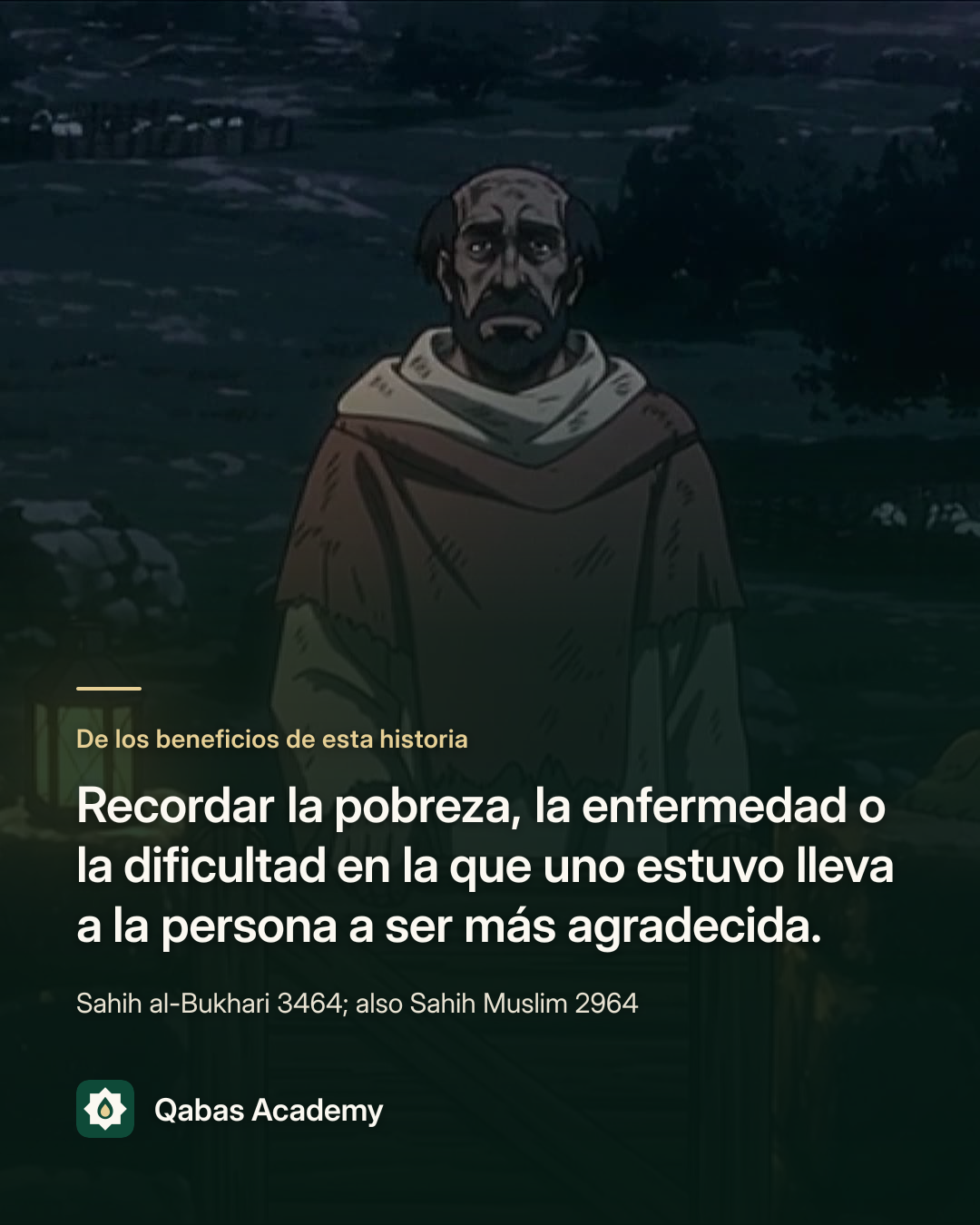
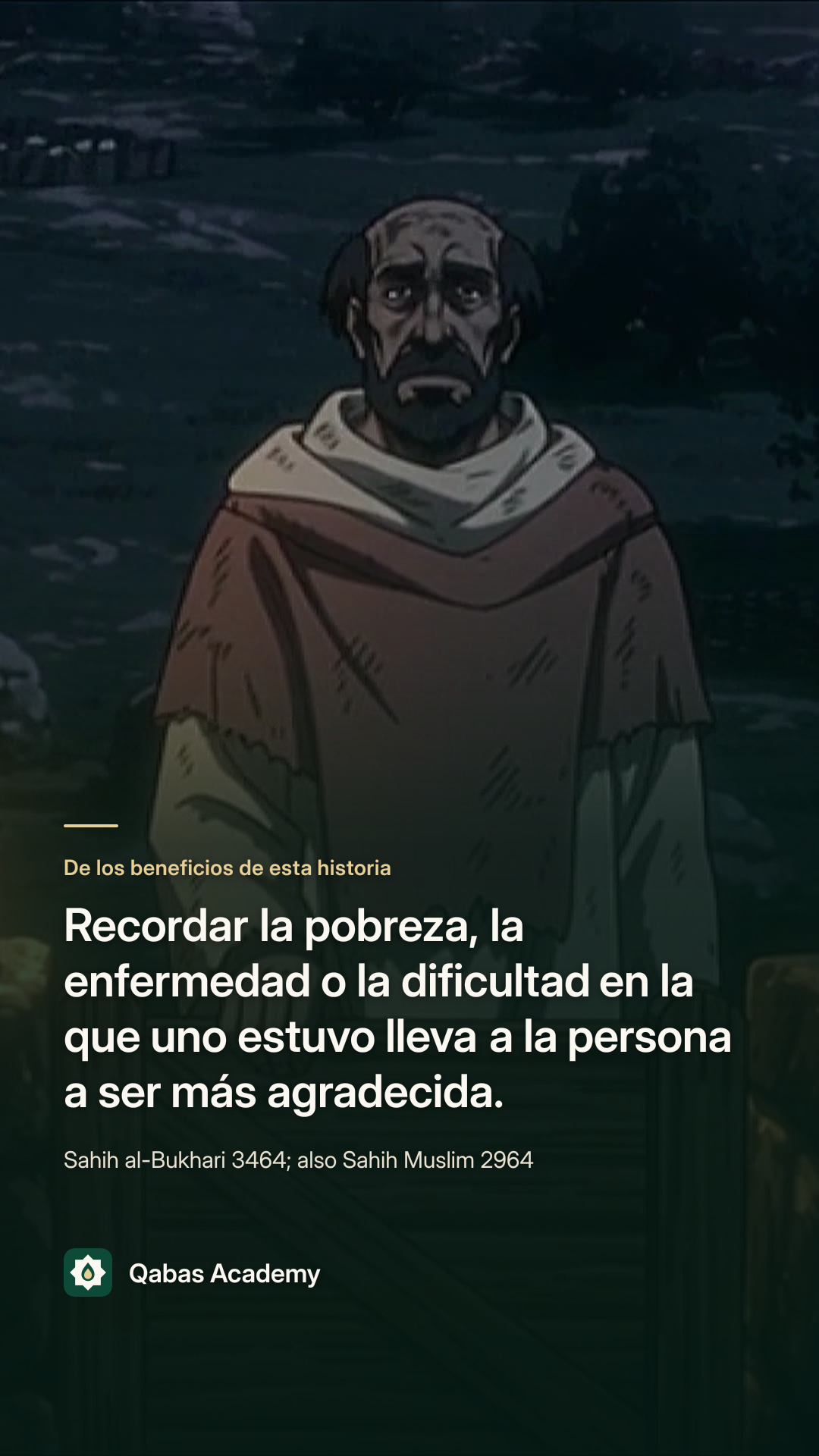
- Recordar la pobreza, la enfermedad o la dificultad en la que uno estuvo lleva a la persona a ser más agradecida.[5]
- Al-Nawawi (vol. 18, p. 399) extrae de él el estímulo a ser amable con los débiles, a honrarlos y darles lo que piden cuando sea posible, y una advertencia contra herir sus corazones o mirarlos por encima del hombro; y que uno debe hablar de las bendiciones de Allah, no negarlas.[9]
- La paciencia en la aflicción puede ser mejor para quien la sufre que verse libre de ella.[5]
- Ibn Hayar (vol. 6, p. 581) señala que aquí se condena la tacañería porque llevó a los dos hombres a mentir y a negar la bendición de Allah.[8]
- Las personas difieren mucho en cómo agradecen a Allah y en cómo benefician a los demás.[10]
Preguntas para reflexionar
Estas preguntas las ha escrito Qabas Academy para ayudarte a reflexionar. No forman parte del hadiz ni de su comentario.
- ¿Qué bendición tratas hoy como si la hubieras tenido siempre?
- Los dos hombres dijeron «esto lo heredé». ¿En qué momentos explicamos los dones de Allah como si fueran logros nuestros?
- El ángel llegó con el aspecto que ellos tenían antes. ¿Quién a tu alrededor se parece a la persona que tú solías ser?
- ¿Te saldría con facilidad la respuesta del ciego? ¿Qué te la haría más fácil?
Tarjeta de reflexión
Una tarjeta con una reflexión de este episodio y su fuente, lista para compartir.
Más episodios
 1:47Hadices en animeEl hombre que mató a 99 personas
 2:11Hadices en animeLos tres hombres atrapados en la cueva
 Reproduciendo2:04Hadices en animeEl leproso, el calvo y el ciego
 3:54Historias del CoránEl Día del Juicio
 17:11Historias del CoránLa historia del profeta Yusuf (la paz sea con él)
 1:31Hadices en animeEl hombre que pidió prestados 1.000 dinares