 English
 Español
 Русский
 中文
中文 Türkçe
 اردو
اردو Italiano
 Français
 Deutsch
Hadith in Anime
The Leper, the Bald Man and the Blind Man
Source & authenticity: Sahih al-Bukhari 3464Sahih (authentic)
- Collection
- Sahih al-Bukhari
- Narration
- Sahih al-Bukhari 3464In-book reference: Book 60 (Prophets), Hadith 131
- Grading
- Sahih (authentic)HadeethEnc, Al-Durar al-Saniyyah
- Also reported in
- Sahih Muslim 2964
Translation: Dr
Open on sunnah.comThree men are each given what they longed for, and each is later tested on how he remembers where it came from.
Subtitles in 9 languages: choose yours with the CC button on the video. Watching needs no account.
The hadith
English translation by Dr. M. Muhsin Khan, as published on Sunnah.com. Sahih al-Bukhari 3464
Source & authenticity
- Narration
- Sahih al-Bukhari 3464 (In-book reference: Book 60 (Prophets), Hadith 131)
- Also reported in
Sahih Muslim 2964 (Book 55 (The Book of Zuhd and Softening of Hearts), Hadith 15)The same story from Abu Hurayrah with slight differences in wording.
- Grading
Sahih (authentic)
Sources
- [1] Sahih al-Bukhari 3464, Prophets, Sunnah.com (accessed 2026-10-15)Arabic text and English translation (Dr. M. Muhsin Khan).
- [2] Sahih Muslim 2964, The Book of Zuhd and Softening of Hearts, Sunnah.com (accessed 2026-10-15)Arabic text and English translation (Abdul Hamid Siddiqui).
- [3] HadeethEnc, hadith 5926 (English), Encyclopedia of Translated Prophetic Hadiths (accessed 2026-10-15)Explanation and grading.
- [4] HadeethEnc, hadith 5926 (Arabic), benefits of the hadith, Encyclopedia of Translated Prophetic Hadiths (accessed 2026-10-15)Benefits translated from Arabic by Qabas Academy.
- [5] Al-Durar al-Saniyyah, explanation of Sahih al-Bukhari 3464, Al-Durar al-Saniyyah (accessed 2026-10-15)Arabic explanation, summarised and translated by Qabas Academy.
- [6] Riyad as-Salihin 65, Chapter: Watchfulness (al-Nawawi), Sunnah.com (accessed 2026-10-15)
- [7] Quran 21:35, Saheeh International translation, Quran.com (accessed 2026-10-15)
- [8] Ibn Hajar al-Asqalani, Fath al-Bari, vol. 6, pp. 579-581 (Book of the Prophets, hadith of the leper, the blind man and the bald man, commentary on Sahih al-Bukhari 3464), Islamweb.net library (accessed 2026-10-16)Arabic, summarised and translated by Qabas Academy.Pages opened: pp. 579-581
- [9] Al-Nawawi, Sharh Sahih Muslim (al-Minhaj), vol. 18, pp. 398-399 (Book of Zuhd and Softening of Hearts), Islamweb.net library (accessed 2026-10-16)Arabic, summarised and translated by Qabas Academy.Pages opened: pp. 398-399
- [10] Muhammad ibn Salih al-Uthaymeen, Sharh Riyad as-Salihin, vol. 1, pp. 498-507 (Chapter of Watchfulness, hadith 65), Al-Maktaba al-Shamila (shamela.ws), Dar al-Watan edition, Riyadh 1426 AH, page numbers as printed (accessed 2026-10-16)Read on Shamela because binothaimeen.net does not publish this text online: its reading library offers only the index of the volume (official PDF, 10 pages), whose page numbers match this edition. Arabic, summarised and translated by Qabas Academy.Pages opened: p. 498, p. 499, p. 500, p. 501, p. 502, p. 503, p. 504, p. 505, p. 506, p. 507
Explanation
- Al-Durar al-Saniyyah begins by noting that the Prophet (peace be upon him) taught by bringing meanings close to people through stories and examples.[5]
- Ibn Uthaymeen (vol. 1, pp. 500-501) explains how to treat reports about the Children of Israel. What comes in the Quran or the authentic Sunnah, like this hadith, is true without doubt. What comes from their own scholars is rejected if our law shows it to be false, accepted if our law confirms it, and otherwise neither believed nor denied, though there is no harm in telling it to encourage good or warn against evil.[10]
- The Arabic wording, bada lillahi an yabtaliyahum, literally speaks of the test as something that became apparent to Allah. Al-Durar al-Saniyyah explains that it means the test was already in Allah's knowledge and He willed to make it manifest, not that something became apparent to Him after being hidden, which is impossible for Allah.[5]
- HadeethEnc explains that the three were poor, each with a physical affliction, and that Allah wanted to test their faith and gratitude, so He sent them an angel in the form of a man.[3]
- Ibn Hajar (vol. 6, p. 579), whose explanation al-Durar al-Saniyyah follows, adds that Muslim's narration uses a different verb (arada, to will), and that the soundest reading is that Allah decreed to test them, never a change in what He knew.[8]
- Each received what he longed for: good skin, good hair, restored sight, and then a pregnant camel, a pregnant cow and a sheep with young. The narrator was unsure whether the leper asked for camels or cows; HadeethEnc considers camels "most probable", since he was given a she-camel. Al-Durar al-Saniyyah notes that a she-camel ten months pregnant was among the most precious kinds of camel.[1][3][5]
- Ibn Uthaymeen (vol. 1, p. 502) explains the purpose: Allah tests a servant with hardship to see whether he is patient or resentful, and with ease to see whether he is grateful or stingy.[10]
- Then came the test. The angel returned to each in the form and appearance he used to have, as a stranded traveller. The leper and the bald man refused and claimed they had inherited their wealth. HadeethEnc describes this as denial of Allah's favours, "prompted by his miserliness".[1][3]
- The blind man acknowledged where everything came from: he had been blind and Allah restored his sight, he had been poor and Allah made him rich. He told the traveller to take whatever he wished. The angel told him they had been tested, that Allah was pleased with him and displeased with his two companions.[1]
- Ibn Uthaymeen (vol. 1, p. 503) points to a detail: the blind man asked only for sight to see people, and chose sheep rather than camels or cows, signs of his detachment, while the other two asked for more than they needed.[10]
- HadeethEnc adds that Allah tested them so that they would be rewarded "based on what you did, not based on His foreknowledge". Imam al-Nawawi placed this hadith in the chapter on Watchfulness (al-Muraqabah) of Riyad as-Salihin (no. 65).[3][6]
- Ibn Hajar (vol. 6, p. 580) explains that the angel came to each man in the very form he had before, to make the proof against him stronger, and reports Ibn al-Tin's view that the traveller's words were indirect speech, a picture meant to awaken the listener to his own past.[8]
- What happened to the two afterwards? Ibn Hajar (vol. 6, p. 581) says the apparent meaning is that it befell them as the angel said, and Ibn Uthaymeen (vol. 1, p. 505) that Allah apparently answered the angel's prayer and returned them to their poverty and illness. Ibn Hajar also notes that telling such stories of past people to draw lessons is allowed and is not backbiting, which may be why they are not named.[8][10]
- On the leper's excuse that he had many obligations, Ibn Uthaymeen (vol. 1, p. 504) comments that he apparently fulfilled none of them, since a poor traveller who is stranded is among the most deserving of help.[10]
Lessons and benefits
- Gratitude for Allah's blessings in wealth is an obligation, and so is giving Allah's due from it.[4]
- Allah tests His servants with blessings, as He says: "And We test you with evil and with good as trial; and to Us you will be returned" (Quran 21:35, Saheeh International).[4][7]
- Attributing a blessing to Allah is gratitude for it and a reason it remains; attributing it to anyone else is ingratitude and a reason it is lost.[4]
- Gratitude is a cause for blessings to remain and grow, as Ibn Uthaymeen (vol. 1, pp. 505 and 507) explains, citing Quran 14:7; acknowledging Allah's favour and paying what is due from one's wealth keep blessing in it.[10]
- It is correct to say billahi thumma bik (by Allah, then by you), joining the two with thumma (then) and not wa (and), in an expression like this one.[4]
- A warning against ingratitude and stinginess, and encouragement to give charity and to be gentle with and help the weak.[5][4]
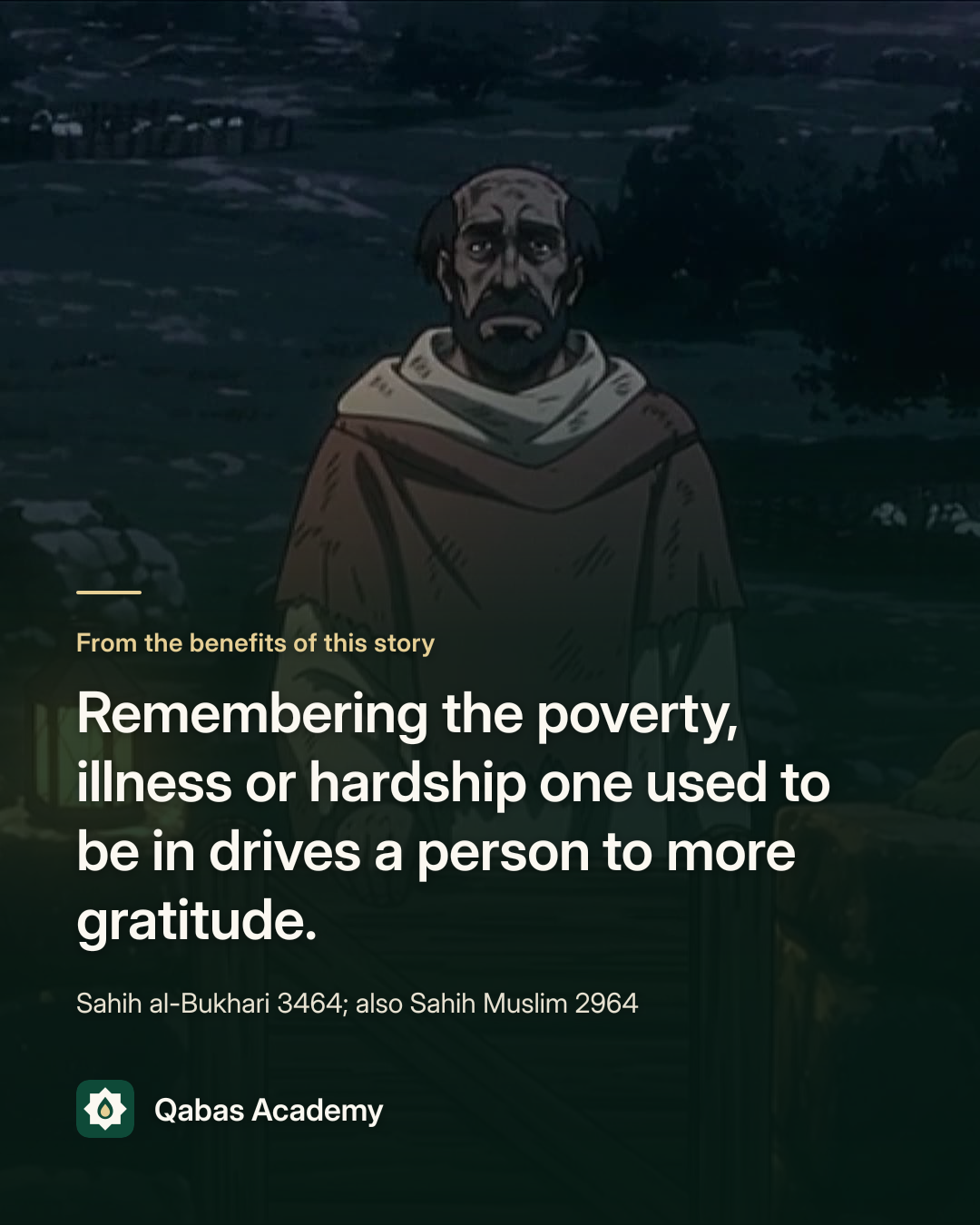
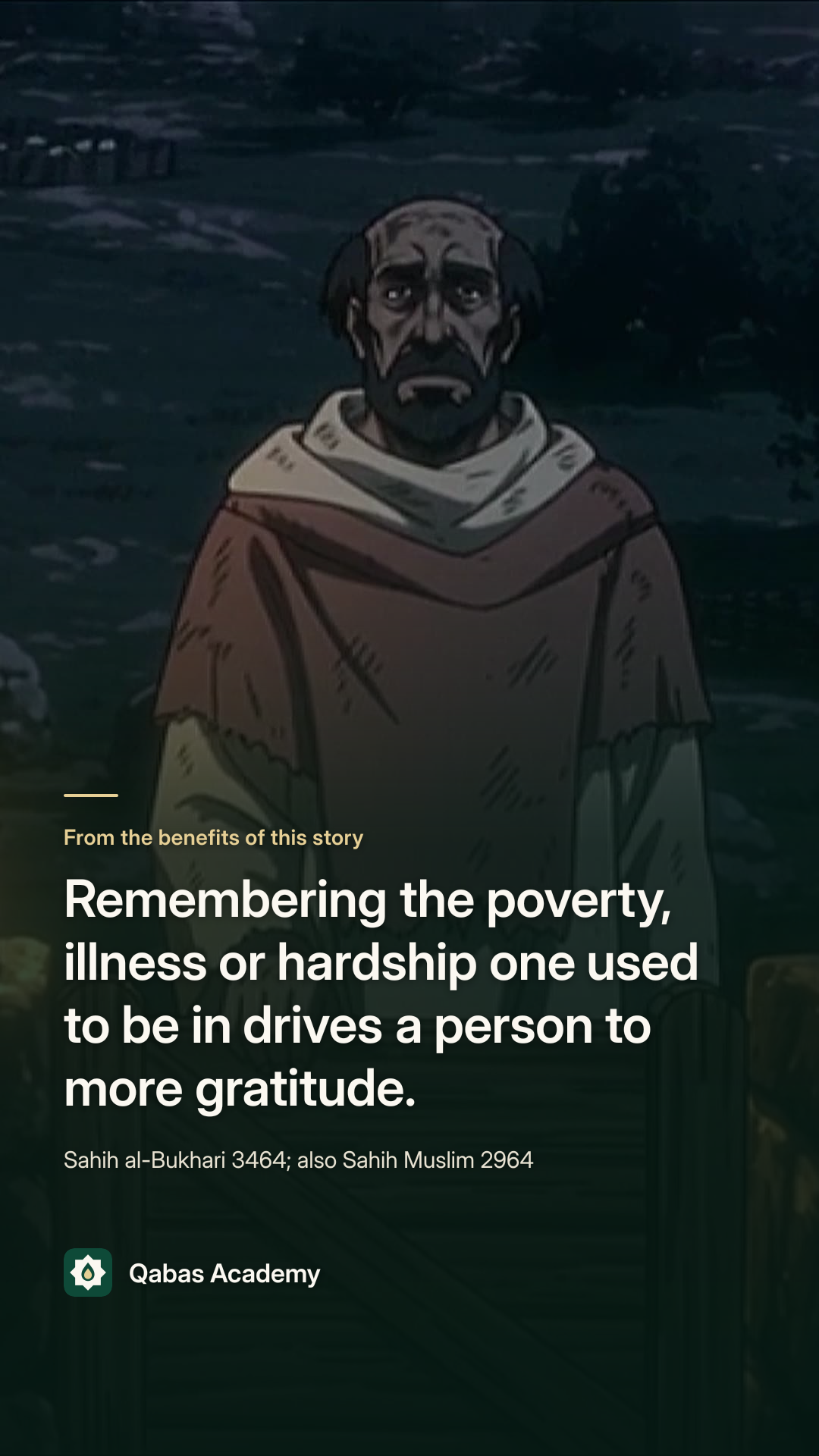
- Remembering the poverty, illness or hardship one used to be in drives a person to more gratitude.[5]
- Al-Nawawi (vol. 18, p. 399) draws from it encouragement to be gentle with the weak, to honour them and give them what they ask where possible, and a warning against breaking their hearts or looking down on them; and that one should speak of Allah's blessings, not deny them.[9]
- Patience in affliction can be better for the afflicted person than its removal.[5]
- Ibn Hajar (vol. 6, p. 581) notes that stinginess is condemned here because it drove the two men to lie and to deny the blessing of Allah.[8]
- People differ greatly in how they thank Allah and how they benefit others.[10]
Reflection questions
These questions are written by Qabas Academy to help you reflect. They are not part of the hadith or its commentary.
- Which blessing do you now treat as if you had always had it?
- The two men said "I inherited this". Where do we explain away Allah's gifts as our own achievement?
- The angel came looking like their former selves. Who around you looks like the person you used to be?
- Would the blind man's answer come easily to you? What would make it easier?
Reflection card
A card with one reflection from this episode and its source, ready to share.
More episodes
 1:47Hadith in AnimeThe Man Who Killed 99 People
 2:11Hadith in AnimeThe Three Men Trapped in the Cave
 Now playing2:04Hadith in AnimeThe Leper, the Bald Man and the Blind Man
 3:54Quran StoriesThe Day of Judgement
 17:11Quran StoriesThe Story of Prophet Yusuf (peace be upon him)
 1:31Hadith in AnimeThe Man Who Borrowed 1,000 Dinars