 English
 Español
 Русский
 中文
 Türkçe
 اردو
 Italiano
 Français
 Deutsch
 العربية
Quran Stories
The Cow That Exposed a Killer
Source: 2:67, 2:68, 2:69, 2:70, 2:71, 2:72, 2:73, 2:74
The story of the cow from the Quran (al-Baqarah 2:67-74), animated: a murder no one saw, the people of Musa (Moses), and a cow that reveals the killer. A rich old man is murdered at night and his body is left at another clan's door. The Children of Israel ask Prophet Musa (peace be upon him) to pray, and Allah commands them to slaughter a cow. Instead of obeying, they ask question after question, and every answer makes the task harder. When they finally slaughter it and strike the dead man with a part of it, he rises by the will of Allah and names his killer. A story about obeying Allah's command without looking for excuses.
Original Arabic audio and 9 dubbed languages: choose with the audio button on the video, and subtitles with the CC button. Watching needs no account.
The verses
Published translation consulted: Saheeh International, as shown on Quran.com.
Source
- Verses
- Al-74
- Published translation consulted
- Saheeh International, as shown on Quran.com
- Meaning in plain language (Qabas Anime)
- 2:67, 2:68, 2:70, 2:72, 2:73
- Tafsir
- Tafsir Ibn Kathir (Abridged), English, Quran.comAl-Qurtubi, al-Jami' li-Ahkam al-Qur'an (Arabic), on Quran 2:67, Quran.comAl-Qurtubi, al-Jami' li-Ahkam al-Qur'an (Arabic), on Quran 2:68, Quran.comAl-Qurtubi, al-Jami' li-Ahkam al-Qur'an (Arabic), on Quran 2:70, Quran.comAl-Qurtubi, al-Jami' li-Ahkam al-Qur'an (Arabic), on Quran 2:71, Quran.comAl-Qurtubi, al-Jami' li-Ahkam al-Qur'an (Arabic), on Quran 2:72, Quran.comAl-Qurtubi, al-Jami' li-Ahkam al-Qur'an (Arabic), on Quran 2:74, Quran.comAt-Tabari, Jami' al-Bayan (Arabic), on Quran 2:67, Quran.comAt-Tabari, Jami' al-Bayan (Arabic), on Quran 2:70, Quran.comAt-Tabari, Jami' al-Bayan (Arabic), on Quran 2:74, Quran.comAs-Sa'di, Taysir al-Karim ar-Rahman (Arabic), on Quran 2:67, Quran.comAs-Sa'di, Taysir al-Karim ar-Rahman (Arabic), on Quran 2:72, Quran.comAs-Sa'di, Taysir al-Karim ar-Rahman (Arabic), on Quran 2:73, Quran.comAs-Sa'di, Taysir al-Karim ar-Rahman (Arabic), on Quran 2:74, Quran.com
Sources
- [1] Quran 2:67-74, Surah Al-Baqarah, Quran.com (accessed 2026-10-24)Arabic text (Uthmani script) and English translation by Saheeh International. The Arabic shown on this page is the Tanzil Uthmani text (see arabic_source).Pages opened, by verse: 2:67, 2:68, 2:69, 2:70, 2:71, 2:72, 2:73, 2:74
- [2] Quran 2:285, Surah Al-Baqarah, Quran.com (accessed 2026-10-24)Arabic text (Uthmani script) and English translation by Saheeh International.
- [3] Tafsir Ibn Kathir (Abridged), English, Quran.com (accessed 2026-10-24)The abridged English translation of Ibn Kathir's Tafsir al-Qur'an al-'Azim, as shown on Quran.com under "Ibn Kathir (Abridged)". Quran.com shows the commentary for a group of verses (2:67; 2:68-71; 2:72-73; 2:74); the page opened for each group is listed. Summarised in our own words.Pages opened, by verse: 2:67, 2:68, 2:72, 2:74
- [4] Al-Qurtubi, al-Jami' li-Ahkam al-Qur'an (Arabic), on Quran 2:67, Quran.com (accessed 2026-10-24)Arabic, as shown on Quran.com; summarised and translated by Qabas Anime. Quran.com shows this commentary verse by verse; this page is the commentary on the verse named.
- [5] Al-Qurtubi, al-Jami' li-Ahkam al-Qur'an (Arabic), on Quran 2:68, Quran.com (accessed 2026-10-24)Arabic, as shown on Quran.com; summarised and translated by Qabas Anime. Quran.com shows this commentary verse by verse; this page is the commentary on the verse named.
- [6] Al-Qurtubi, al-Jami' li-Ahkam al-Qur'an (Arabic), on Quran 2:70, Quran.com (accessed 2026-10-24)Arabic, as shown on Quran.com; summarised and translated by Qabas Anime. Quran.com shows this commentary verse by verse; this page is the commentary on the verse named.
- [7] Al-Qurtubi, al-Jami' li-Ahkam al-Qur'an (Arabic), on Quran 2:71, Quran.com (accessed 2026-10-24)Arabic, as shown on Quran.com; summarised and translated by Qabas Anime. Quran.com shows this commentary verse by verse; this page is the commentary on the verse named.
- [8] Al-Qurtubi, al-Jami' li-Ahkam al-Qur'an (Arabic), on Quran 2:72, Quran.com (accessed 2026-10-24)Arabic, as shown on Quran.com; summarised and translated by Qabas Anime. Quran.com shows this commentary verse by verse; this page is the commentary on the verse named.
- [9] Al-Qurtubi, al-Jami' li-Ahkam al-Qur'an (Arabic), on Quran 2:74, Quran.com (accessed 2026-10-24)Arabic, as shown on Quran.com; summarised and translated by Qabas Anime. Quran.com shows this commentary verse by verse; this page is the commentary on the verse named.
- [10] At-Tabari, Jami' al-Bayan (Arabic), on Quran 2:67, Quran.com (accessed 2026-10-24)Arabic, as shown on Quran.com; summarised and translated by Qabas Anime. Quran.com shows this commentary verse by verse; this page is the commentary on the verse named.
- [11] At-Tabari, Jami' al-Bayan (Arabic), on Quran 2:70, Quran.com (accessed 2026-10-24)Arabic, as shown on Quran.com; summarised and translated by Qabas Anime. Quran.com shows this commentary verse by verse; this page is the commentary on the verse named.
- [12] At-Tabari, Jami' al-Bayan (Arabic), on Quran 2:74, Quran.com (accessed 2026-10-24)Arabic, as shown on Quran.com; summarised and translated by Qabas Anime. Quran.com shows this commentary verse by verse; this page is the commentary on the verse named.
- [13] As-Sa'di, Taysir al-Karim ar-Rahman (Arabic), on Quran 2:67, Quran.com (accessed 2026-10-24)Arabic, as shown on Quran.com; summarised and translated by Qabas Anime. Quran.com shows this commentary verse by verse; this page is the commentary on the verse named.
- [14] As-Sa'di, Taysir al-Karim ar-Rahman (Arabic), on Quran 2:72, Quran.com (accessed 2026-10-24)Arabic, as shown on Quran.com; summarised and translated by Qabas Anime. Quran.com shows this commentary verse by verse; this page is the commentary on the verse named.
- [15] As-Sa'di, Taysir al-Karim ar-Rahman (Arabic), on Quran 2:73, Quran.com (accessed 2026-10-24)Arabic, as shown on Quran.com; summarised and translated by Qabas Anime. Quran.com shows this commentary verse by verse; this page is the commentary on the verse named.
- [16] As-Sa'di, Taysir al-Karim ar-Rahman (Arabic), on Quran 2:74, Quran.com (accessed 2026-10-24)Arabic, as shown on Quran.com; summarised and translated by Qabas Anime. Quran.com shows this commentary verse by verse; this page is the commentary on the verse named.
Explanation
- Among the Children of Israel, in the time of Prophet Moses (peace be upon him), a man was killed and no one knew who had done it. People argued and blamed one another (2:72). The scholar Ibn Kathir, in his commentary on the Quran, records from one of the early scholars that the victim was a rich man whose only heir was his nephew. The nephew killed him, left the body at the door of another man, and the next morning cried out for revenge, until people took up weapons and almost fought. They went to Moses, and he told them that Allah commanded them to slaughter a cow (2:67). The scholar as-Sa'di explains that they disagreed about who the killer was, and that serious harm would have broken out among them if Allah had not made the truth clear.[1][3][13]
- Their first answer to Moses was: "Do you take us in ridicule?" He replied that he sought refuge in Allah from being among the ignorant (2:67). As-Sa'di explains that they should have hurried to obey the command without objecting, and that an ignorant person is one who says useless things and makes fun of people. The scholar al-Qurtubi draws from this verse that mocking the religion of Allah is not allowed and is a form of ignorance, while ordinary joking is not the same as mocking.[1][13][4]
- Why a cow? The verses do not say, and the scholars offered explanations. Al-Qurtubi reports from the scholar al-Mawardi, who adds that Allah knows best, that they were told to slaughter a cow because it was the same kind of animal as the calf they had once worshipped instead of Allah: this would make it lose its importance in their eyes, and their response would show whether any of that worship was still in their hearts. He adds a deeper meaning: a dead man brought back to life through the killing of a living animal shows Allah's power even more clearly.[4]
- Instead of simply obeying, they asked question after question: how old the cow should be, what color, and which one, since all cows looked alike to them (2:68-71). Each answer made the search harder. Ibn Kathir records that Ibn Abbas, a companion of the Prophet Muhammad (peace be upon him), said that any cow at all would have been enough; they made the matter hard for themselves, so Allah made it hard for them. At-Tabari and al-Qurtubi record the same words from him, and as-Sa'di explains that they made it hard by asking so many questions. Al-Qurtubi adds that the religion of Allah is easy, and that digging into needless questions put to prophets and scholars is a fault.[1][3][11][5][14][7]
- In their last question they added: if Allah wills, we will be guided (2:70). The early scholar Ikrima said, as at-Tabari records, that any cow would have been enough for them, and that if they had not said these words, if Allah wills, they would not have found it. As-Sa'di says the same: without them, they would not have been guided to the cow. Al-Qurtubi explains that these words showed they were beginning to turn back, to give in, and to regret not having obeyed. Ibn Kathir records that the owner of the cow would sell it only for its skin filled with gold. "So they slaughtered her, but they could hardly do it" (2:71): Ibn Abbas explained that they did not want to slaughter it.[1][11][14][6][3]
- At-Tabari also records a story, told by the early scholar as-Suddi, about the owner of the cow: a young man who was among the kindest of people to his father. A merchant came to sell him a pearl while his father was asleep with the key under his head. The young man would not wake his father, even when the merchant kept lowering the price if only he would wake him, and in the end he did not buy it at all. In return, the story says, Allah gave him this cow. This is a story of the Children of Israel that we neither confirm nor deny. As-Sa'di reminds readers that the Prophet Muhammad (peace be upon him) said not to believe the People of the Book (Jews and Christians) in such reports and not to deny them, and that such stories must never be taken as the meaning of the Quran itself.[10][16]
- Allah told them to strike the dead man with part of the cow (2:73). He came back to life, and Ibn Kathir records that when they asked him who had killed him, he pointed to his nephew, and then died again. The nephew was not allowed to inherit from him, and from then on no one who killed to gain an inheritance was allowed to inherit. Al-Qurtubi reports that Ibn Abbas said the man had killed his uncle in order to inherit from him, and writes that the scholars do not disagree that a person who kills on purpose inherits nothing from the one he killed, neither the money paid for the death nor the wealth, apart from a small group that went against all the others.[1][3][8]
- Allah says that this is how He brings the dead to life and shows people His signs (2:73). Ibn Kathir explains that this showed Allah's power to bring the dead back to life and was proof that all the dead will be raised again; he counts five places in this chapter of the Quran where Allah speaks of bringing the dead to life. As-Sa'di adds that Allah brought out what they had been hiding: the dead man told them who had killed him, and seeing him come back to life before their eyes pointed to how Allah will bring the dead to life. We are not told which part of the cow was used; Ibn Kathir explains that knowing it would not benefit us, otherwise Allah would have made it clear.[1][3][15]
- Yet after all this, their hearts became hard, "like stones or even harder" (2:74). Ibn Kathir explains that their hearts became harder than stones, with no hope of softening, and records that Ibn Abbas said some stones are softer than their hearts. As-Sa'di notes that stones are harder than iron, because iron and lead melt in fire while stones do not; and yet some stones let rivers burst out, some split so that water comes out, and some fall down for fear of Allah. The scholar Qatada said, as at-Tabari and al-Qurtubi record, that Allah excused the stones but did not excuse the wretched among human beings.[1][3][16][12][9]
Lessons and benefits
- When a command from Allah comes, the right answer is to obey it straight away, as the believers say: "We hear and we obey."[2][13]
- Looking for one more question to put off obeying only makes things harder: any cow would have been enough, but they made it hard for themselves, so it was made hard for them.[3][11][14]
- The religion of Allah is easy; turning a simple instruction into endless details is a fault, not a sign of care.[7]
- Tie your plans to what Allah wills: the early scholars said that these words were the reason they finally found the cow.[1][11][14]
- A crime can be hidden from people, but not from Allah: He brought out what they were hiding, and the man who killed for an inheritance lost it.[1][3][8]
- The dead man brought back to life is a sign that Allah will bring all the dead back to life.[1][3][15]
- Seeing signs is not enough: a heart that keeps refusing becomes harder than stone, so keep your heart soft by obeying.[1][3][16][12]
Reflection questions
These questions are written by Qabas Anime to help you reflect. They are not part of the Quran or its tafsir.
- When you are asked to do something you know is right, do you sometimes look for one more question so you can put it off?
- Which simple good deed have you made complicated for yourself?
- The killer was the one who wept the most and demanded justice the loudest. What does this teach you about judging people by how they look in public?
- What softens your heart, and what has been making it harder lately?
Transcript
The words of the episode, from the English subtitles of the original voice.
On a cold night… an old man was walking alone. He did not know… that eyes were following him in the dark. He stopped… turned around… and saw no one.
And in a moment… it was all over.
The killer ran away… and no one saw him. No one but Allah.
A crime with no witness and no proof… that Allah would expose… with a cow. “And remember when you killed a man and blamed one another for it, but Allah was going to bring out what you were hiding.” (Quran 2:72) This happened among the Children of Israel… in the time of Prophet Moses, peace be upon him. Among them was a very rich old man: wide lands… flocks of sheep… and chests full of silver.
But he had no children.
He ate alone… he slept alone… in a big, silent house. So when he died… his relatives would inherit everything.
Some of them visited him every day… and kept asking how he was.
But people cannot see into hearts… only what shows on faces. At dawn… a woman of the town went to the well with her jar… Suddenly… she saw something she could not believe.
He was lying at the door of another clan… as if the killer wanted to blame the crime on them. People gathered around him…
His relatives came, weeping… His nephew cried out in tears: “My uncle… who did this to you?” Another relative said: “You killed him! He was found at your door.” The owner of the house said: “By Allah, we did not kill him… and we don’t know who did.” The anger grew… voices were raised… and each side took up its weapons. Blood was about to bring more blood… and one crime was about to become a war.
They pushed the blame back and forth… each side throwing it on the other… while the killer stood among them… hearing and watching. Then some wise men stepped between them: “Will you kill each other… while a Messenger of Allah is among you?”
“Go to Moses.”
So they went to Prophet Moses, peace be upon him… and told him what had happened. Their elder said: “O Prophet of Allah… one of our men was killed… and we don’t know who killed him.” And the dead man’s nephew said: “O Prophet of Allah… pray to your Lord for us… to show us who killed my uncle.” So Moses prayed to his Lord… and a command came from Allah… a command no one expected. Moses told them: “Allah commands you… to slaughter a cow.” A cow? They were asking about a killer… and they were told to slaughter a cow? One of them said, mocking: “Are you making fun of us, Moses?” Moses said: “Allah forbid! Only a fool makes fun of people… about a command from Allah.” A prophet only speaks the truth about Allah. But they did not do it… One of them said: “Which cow should we slaughter? We have to ask him.”
So they went back to Moses and said: “O Moses… ask your Lord for us… what kind of cow is it?” Moses told them: “It is not old and worn out… nor so young that it has never had a calf… but in between. So go and do what you were told.” But they came back with more questions… One of them said: “O Moses… what color is it?” Moses said: “It is yellow… a deep, bright yellow… pure and shining… a joy to everyone who looks at it.” And the more they asked… the harder it became for them. Then they asked a third time: “O Moses… which cow is it? All cows look alike to us… Then they said: “We will find it… if Allah wills.” Moses told them: “It has never been used to plow the land… or to water the fields… it has no defect at all… and not a single spot of another color.” Ibn Abbas, a companion of the Prophet Muhammad (peace be upon him), said: “Any cow at all would have been enough for them… but they made it hard for themselves… so Allah made it hard for them.” So they went out searching for it… in the markets, on the farms, in faraway villages.
This one is too old… this one is too young… this one has plow marks on its neck… this one has a black spot. A herdsman told them: “You are looking for a cow that does not exist.” Until at last they found it… with a poor young man. One of the early scholars said: “If they had not said, ‘if Allah wills’… they would never have found it.” Some scholars who explain the Quran tell a story about this young man, one of the stories of the Children of Israel… that we neither confirm nor deny. They say he was very good to his father. One day a merchant came to him with a precious jewel… but the key was under his sleeping father’s head.
The young man told the merchant: “I will not wake my father.” The merchant left with his jewel… and the young man accepted the loss. So Allah gave him something better in return… this cow, whose like they had found nowhere on earth. The elder said to him: “Sell us your cow.” The young man shook his head… and every time they offered more, he refused. When he saw how badly they needed it, he raised the price. It is said they paid for it with its hide filled with gold. They led it to the town… and they almost did not do it: because of the high price, and all their arguing… and some say, out of fear the killer would be exposed. In the morning, they brought it into the town… and people came out of their houses… one after another. They slaughtered it… as Allah had commanded them. Then Allah commanded them… to strike the dead man with a part of the cow. They struck him… and everything went silent.
Then… he moved.
He opened his eyes… and the dead man rose, alive… by the will of Allah.
They asked him: “Who killed you?” He raised his trembling hand… and pointed… and said: “My killer is… my brother’s son.”
Everyone turned… to look at him.
Then he fell back… and was dead again, as before.
His own nephew… the one who wept for him more than anyone… and demanded revenge from innocent people.
He denied it… and said: “By Allah, I did not kill him!” He denied the truth after seeing it with his own eyes. He killed him to inherit his wealth… so Allah took the inheritance away from him. It is said: after the killer in the story of the cow, no killer ever inherited again. And all scholars agree: whoever kills on purpose… cannot inherit from the one he killed. This is how Allah brings the dead back to life. They saw with their own eyes a dead man rise and speak… so they would know that the One who brought him back… can bring all people back to life on the Day of Judgment. And after everything they saw… their hearts became hard. Their hearts became like stones… or even harder.
Because rivers can burst out of a rock… a rock can crack open… and water flows out of it… a rock can fall out of fear of Allah… but nothing good comes out of a hard heart. The scholar Qatada said: “Allah excused the stones… but not the wretched among mankind.” So ask yourself: how many times did a clear command from Allah reach you… and you looked for a question to put off obeying? How many times did you see a sign from Allah… and then go back to how you were? The heart grows soft by obeying… and hard by being stubborn. So when a command from Allah reaches you… say: “We hear, and we obey.” “So We said, “Strike him with part of it.” This is how Allah brings the dead to life, and He shows you His signs so that you may understand. Then your hearts became hardened after that, being like stones or even harder. For indeed, there are stones from which rivers burst forth, and there are some of them that split open and water comes out, and there are some of them that fall down for fear of Allāh. And Allāh is not unaware of what you do.” (Quran 2:73–74)
Related episodes


More episodes
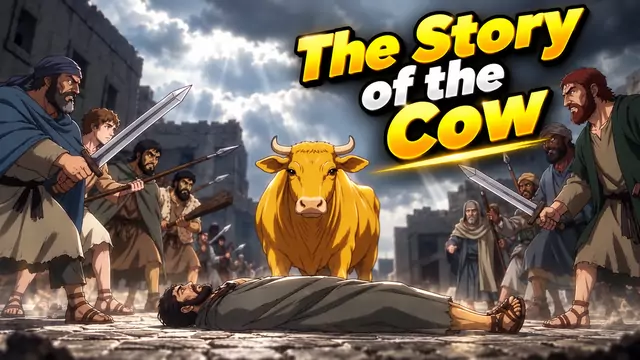 Now playing12:54Quran StoriesThe Cow That Exposed a Killer
 4:42Hadith in AnimeThe Man Who Gave Charity Three Nights
 7:32Hadith in AnimeThe Boy and the King
 7:17Hadith in AnimeJuraij and His Mother's Prayer
 3:30Quran StoriesThe Story of Gog and Magog
 2:28Hadith in AnimeThe Hadith of Jibril
 3:49Islamic StoriesThe King and the Grateful Minister
 1:47Hadith in AnimeThe Man Who Killed 99 People
 2:11Hadith in AnimeThe Three Men Trapped in the Cave
 2:04Hadith in AnimeThe Leper, the Bald Man and the Blind Man
 3:54Quran StoriesThe Day of Judgement
 17:11Quran StoriesThe Story of Prophet Yusuf (peace be upon him)
 1:31Hadith in AnimeThe Man Who Borrowed 1,000 Dinars