 English
 Español
 Русский
 中文
 Türkçe
 اردو
 Italiano
 Français
 Deutsch
 العربية
Hadith in Anime
The Boy and the King
Source & authenticity: Sahih Muslim 3005Sahih (authentic)
- Collection
- Sahih Muslim
- Narration
- Sahih Muslim 3005In-book reference: Book 55 (The Book of Zuhd and Softening of Hearts), Hadith 93
- Grading
- Sahih (authentic)Sahih Muslim 3005, Ibn Kathir, Jami` at-Tirmidhi 3340
- Also reported in
- Jami` at-Tirmidhi 3340
Translation: Abdul Hamid Siddiqui
Open on sunnah.comA king had an old sorcerer, who asked him for a boy to teach. On his way, the boy met a monk and came to believe in Allah. When a huge beast blocked the people's path, he prayed and killed it with a stone. He healed the blind and the lepers, always saying that it is Allah who heals. The king tortured those who believed and twice tried to kill the boy, on a mountain and at sea, and twice Allah saved him. Then the boy told the king the only way he could kill him: before all the people, saying "In the name of Allah, Lord of the boy". The king did it, the boy died, and the people believed. A story about steadfastness and about relying on Allah alone, recalled in Surah al-Buruj.
Original Arabic audio and 9 dubbed languages: choose with the audio button on the video, and subtitles with the CC button. Watching needs no account.
The hadith
English translation by Abdul Hamid Siddiqui, as published on Sunnah.com. Sahih Muslim 3005
Source & authenticity
- Narration
- Sahih Muslim 3005 (In-book reference: Book 55 (The Book of Zuhd and Softening of Hearts), Hadith 93)
- Also reported in
Jami` at-Tirmidhi 3340 (Book 47 (Chapters on Tafsir), Hadith 392)In the chapter on Surat al-Buruj, through Ma'mar from Thabit al-Bunani from 'Abd al-Rahman ibn Abi Layla from Suhaib, the same chain as Muslim's after Thabit. Here the king's man is a soothsayer (kahin) rather than a sorcerer, some narrators say the beast was a lion, the boy asks nothing of the blind man but that he believe in the One who returns his sight, and the narration ends with the recitation of 85:4-8 and the report that the boy was buried.
- Grading
Sahih (authentic)
- Muslim recorded it in the Book of Zuhd and Softening of Hearts, in the chapter on the story of the People of the Ditch, the sorcerer, the monk and the boy (no. 3005), through Hammad ibn Salama from Thabit from 'Abd al-Rahman ibn Abi Layla from Suhaib. Ibn Kathir, on 85:4, gives it from Imam Ahmad from Suhayb and adds that "Muslim also recorded this Hadith at the end of the Sahih".[1][4]
- Al-Tirmidhi recorded it in his chapters on Tafsir, under Surat al-Buruj (no. 3340), through Ma'mar from Thabit al-Bunani with the same chain to Suhaib, and said: this hadith is hasan gharib. Sunnah.com gives the Darussalam grading of that narration as sahih.[2]
Sources
- [1] Sahih Muslim 3005, The Book of Zuhd and Softening of Hearts, Sunnah.com (accessed 2026-10-22)Suhaib's narration; Arabic text and English translation (Abdul Hamid Siddiqui).
- [2] Jami` at-Tirmidhi 3340, Chapters on Tafsir (Surat al-Buruj), Sunnah.com (accessed 2026-10-22)Ma'mar's narration from Thabit al-Bunani; Arabic text and English translation (Darussalam), graded sahih (Darussalam).
- [3] Al-Nawawi, Sharh Sahih Muslim (al-Minhaj), vol. 18, pp. 420-421 (Book of Zuhd and Softening of Hearts, chapter: the story of the People of the Ditch, the sorcerer, the monk and the boy, commentary on Sahih Muslim 3005), Islamweb.net library (Dar al-Khayr edition, 1416 AH / 1996, page numbers as printed) (accessed 2026-10-22)Arabic, summarised and translated by Qabas Academy.Pages opened: pp. 420-421
- [4] Ibn Kathir, Tafsir al-Qur'an al-'Azim (Abridged), English, on Surah al-Buruj, Quran.com (accessed 2026-10-22)The abridged English translation of Ibn Kathir's Tafsir al-Qur'an al-'Azim, as shown on Quran.com under "Ibn Kathir (Abridged)". Quran.com shows the commentary on 85:1-10 as one group; the page opened for each cited verse is listed. Summarised in our own words.Pages opened, by verse: 85:4, 85:10
- [5] Quran 85:4-10, Surah Al-Buruj, Quran.com (accessed 2026-10-22)Arabic text (Uthmani script) and English translation by Saheeh International.Pages opened, by verse: 85:8, 85:10
Explanation
- The Messenger of Allah (peace be upon him) told of a king among those who came before us who had a sorcerer. When the sorcerer grew old, he asked the king to send him a boy to teach magic. On his way to the sorcerer the boy found a monk, sat with him, listened to his words and was impressed by them, and from then on he stopped with the monk each time he passed.[1][4]
- The sorcerer beat the boy for coming late, and the monk told him: if you fear the sorcerer, say my family kept me, and if you fear your family, say the sorcerer kept me. Al-Nawawi (Sharh Sahih Muslim, vol. 18, p. 420) draws from this that it is permitted to say what is not so in war and the like, and to save a life from ruin, one's own or that of anyone whose life is sacred.[1][3]
- One day a huge beast blocked the people's way, and the boy said, "I will come to know today whether the magician is superior or the monk is superior". He took a stone and asked Allah, if the monk's way was dearer to Him than the sorcerer's, to let it kill the beast so the people could pass; he threw it, the beast died and the people went on. In al-Tirmidhi's narration some said the beast was a lion. Al-Nawawi (vol. 18, p. 420) says the hadith establishes the karamat, the wonders Allah grants His righteous friends.[1][2][3]
- The monk told him, "Sonny, today you are superior to me", warned him that he would be put to a trial, and asked him, if he was, not to point anyone to him.[1]
- The boy began to treat the blind and those with leprosy, and people with every kind of illness. Al-Nawawi (vol. 18, p. 420) explains that the word used for the blind here (al-akmah) means one born blind. A blind companion of the king came with many gifts, promising them all if he were cured. The boy answered, "I myself do not cure anyone. It is Allah Who cures", and said that if he believed in Allah, he would ask Allah for him. In al-Tirmidhi's narration he says, "I do not want this from you."[1][2][3]
- The courtier believed in Allah, and Allah cured him. He came back and sat with the king as before; when the king asked who had restored his sight, he said his Lord, and when the king asked whether he had a Lord other than him, he said, "My Lord and your Lord is Allah". The king tormented him until he pointed to the boy, and then tormented the boy, who still said that only Allah cures, until he pointed to the monk.[1]
- The monk was told to turn back from his religion and refused, and the king had him put to death; then the courtier was told the same, refused, and was put to death in the same way. Both gave their lives rather than give up their faith in Allah.[1][2]
- The boy too refused, and the king handed him to a group of his men to take up a mountain and throw him from its top unless he recanted. There the boy prayed, "O Allah, save me from them (in any way) Thou likest", the mountain shook and they fell, and he came walking back to the king. When the king asked what had happened to the soldiers he had sent with him, the boy said, "Allah has saved me from them". Al-Nawawi (vol. 18, p. 420) explains that the summit (dhurwa) is the top of the mountain and that it shook means it moved violently.[1][3]
- Then the king had him taken out to the middle of the sea in a small boat, to be thrown in unless he recanted. The boy made the same prayer, the boat overturned and his captors drowned, and again he came walking back. Al-Nawawi (vol. 18, p. 420) explains that the qurqur is a small ship, the meaning al-Qadi 'Iyad chose, and that the boat overturned.[1][3]
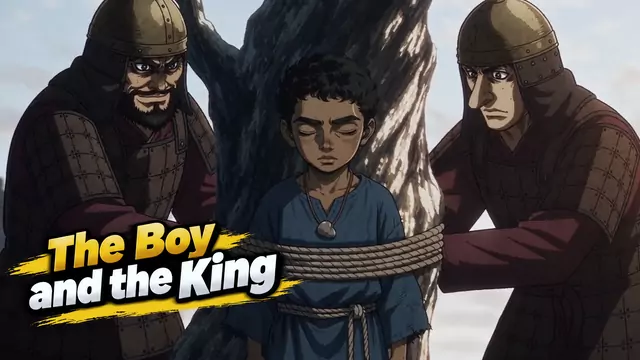
- The boy told the king he could not kill him unless he did as he said: gather the people on one plain, bind him to a tree trunk, take an arrow from his quiver and say, "In the name of Allah, the Lord of the young boy". The king did so, the arrow struck the boy's temple, and he put his hand to it and died. Al-Nawawi (vol. 18, p. 420) explains that the plain (sa'id) here is open, raised ground. The people cried out, "We affirm our faith in the Lord of this young man", three times.[1][3]
- The king was told that what he had feared had come upon him: the people had believed. Al-Nawawi (vol. 18, p. 421) explains that the ukhdud is a great trench in the earth, and that the trenches were dug at the mouths of the roads, at their entrances. Fires were lit in them, and whoever would not turn back from his religion was to be thrown in. Ibn Kathir, on 85:4, adds that Allah decreed what befell these servants of His at the hands of the disbelievers, and He is the Mighty, the Praiseworthy, even if the wisdom of it is hidden from many people.[1][3][4]
- At last a woman came with her child and held back from the fire; al-Nawawi (vol. 18, p. 421) explains that she stayed where she was, unwilling to enter it. Her child spoke to her: in Ibn Kathir's English, "Be patient mother! For verily, you are following the truth!" Allah revealed of them, in Saheeh International's English of 85:8, "And they resented them not except because they believed in Allāh, the Exalted in Might, the Praiseworthy"; Ibn Kathir explains that, in their persecutors' eyes, their only fault was their faith in Allah.[1][3][4][5]
Lessons and benefits
- Hold firm to your faith under pressure: the monk, the courtier, the boy and the believing people all refused to turn back from it.[1][4]
- Only Allah heals: medicine and the people who give it are means, and the cure is from Him alone.[1]
- Do good sincerely, for Allah: the boy wanted no gifts and no credit, only that the man believe in the One who would return his sight.[1][2]
- The boy did not seek death; Allah saved him twice. When he gave his life, it was so that a whole people would come to believe in Allah alone, and those of the trench held to that same truth. Their only fault in their persecutors' eyes was their faith in Allah.[1][4][5]
- Allah suffices those who rely on Him: the boy asked Allah to deal with them as He willed, and each time he could say that Allah had sufficed him against them.[1]
- The door of repentance stays open: even to those who tormented the believers, Allah says in 85:10 that the punishment is for those who then did not repent. Ibn Kathir quotes al-Hasan al-Basri: look at this generosity and kindness, they killed Allah's friends and He still invites them to repent.[5][4]
Reflection questions
These questions are written by Qabas Academy to help you reflect. They are not part of the hadith or its commentary.
- The boy found the monk on his daily way to somewhere else. Who has quietly changed the direction of your life, and have you ever thanked them?
- Offered every gift in the room, the boy said that only Allah cures. When people praise you for something good, how do you turn that praise back to Allah?
- On the mountain and at sea the boy asked Allah to deal with his enemies however He willed. What weighs on you today that you could hand over to Allah in the same way?
- A whole people believed because one young man stayed true. What small, steady act of faith might be someone else's reason to turn to Allah?
More episodes
 Now playing7:32Hadith in AnimeThe Boy and the King
 7:17Hadith in AnimeJuraij and His Mother's Prayer
 3:30Quran StoriesThe Story of Gog and Magog
 2:28Hadith in AnimeThe Hadith of Jibril
 3:49Islamic StoriesThe King and the Grateful Minister
 1:47Hadith in AnimeThe Man Who Killed 99 People
 2:11Hadith in AnimeThe Three Men Trapped in the Cave
 2:04Hadith in AnimeThe Leper, the Bald Man and the Blind Man
 3:54Quran StoriesThe Day of Judgement
 17:11Quran StoriesThe Story of Prophet Yusuf (peace be upon him)
 1:31Hadith in AnimeThe Man Who Borrowed 1,000 Dinars