 English
 Español
 Русский
 中文
中文 Türkçe
 اردو
اردو Italiano
 Français
 Deutsch
Hadith in Anime
The Three Men Trapped in the Cave
Source & authenticity: Sahih Muslim 2743aSahih (authentic)
- Collection
- Sahih Muslim
- Narration
- Sahih Muslim 2743aIn-book reference: Book 49 (The Book of Heart-Melting Traditions), Hadith 13
- Grading
- Sahih (authentic)HadeethEnc, Al-Durar al-Saniyyah
- Also reported in
- Sahih al-Bukhari 2272
Translation: Abdul Hamid Siddiqui
Open on sunnah.comA rock seals three travellers inside a cave, and each one calls on Allah by a sincere deed from his past.
Subtitles in 9 languages: choose yours with the CC button on the video. Watching needs no account.
The hadith
English translation by Abdul Hamid Siddiqui, as published on Sunnah.com. Sahih Muslim 2743a
Source & authenticity
- Narration
- Sahih Muslim 2743a (In-book reference: Book 49 (The Book of Heart-Melting Traditions), Hadith 13)
- Also reported in
Sahih al-Bukhari 2272 (Book 37 (Hiring), Hadith 12)The same story from 'Abdullah ibn 'Umar, with some differences in wording: for example 120 dinars instead of 100, and the third man offering camels, cows, sheep and slaves.
- Grading
Sahih (authentic)
Sources
- [1] Sahih Muslim 2743a, The Book of Heart-Melting Traditions, Sunnah.com (accessed 2026-10-15)Arabic text and English translation (Abdul Hamid Siddiqui).
- [2] Sahih al-Bukhari 2272, Hiring, Sunnah.com (accessed 2026-10-15)Arabic text and English translation (Dr. M. Muhsin Khan).
- [3] HadeethEnc, hadith 10417 (English), Encyclopedia of Translated Prophetic Hadiths (accessed 2026-10-15)Explanation and grading.
- [4] HadeethEnc, hadith 10417 (Arabic), benefits of the hadith, Encyclopedia of Translated Prophetic Hadiths (accessed 2026-10-15)Benefits translated from Arabic by Qabas Academy.
- [5] Al-Durar al-Saniyyah, explanation of Sahih al-Bukhari 2272, Al-Durar al-Saniyyah (accessed 2026-10-15)Arabic explanation, summarised and translated by Qabas Academy.
- [6] Riyad as-Salihin 12, Chapter: Sincerity (al-Nawawi), Sunnah.com (accessed 2026-10-15)
- [7] Ibn Hajar al-Asqalani, Fath al-Bari, vol. 6, pp. 585-590 (Book of the Prophets, chapter of the cave hadith, commentary on Sahih al-Bukhari 3465), Islamweb.net library (accessed 2026-10-16)Ibn Hajar gives his full commentary on this hadith here; at no. 2272 he refers to it. Arabic, summarised and translated by Qabas Academy.Pages opened: pp. 585-590
- [8] Ibn Hajar al-Asqalani, Fath al-Bari, vol. 4, p. 526 (Book of Hiring, commentary on Sahih al-Bukhari 2272), Islamweb.net library (accessed 2026-10-16)Arabic, summarised and translated by Qabas Academy.Pages opened: p. 526
- [9] Al-Nawawi, Sharh Sahih Muslim (al-Minhaj), vol. 17, pp. 214-217 (Book of Heart-Softening Reports, chapter: the story of the three men of the cave), Islamweb.net library (accessed 2026-10-16)Arabic, summarised and translated by Qabas Academy.Pages opened: pp. 214-217
- [10] Muhammad ibn Salih al-Uthaymeen, Sharh Riyad as-Salihin, vol. 1, pp. 78-84 (Chapter of Sincerity, hadith 12), Al-Maktaba al-Shamila (shamela.ws), Dar al-Watan edition, Riyadh 1426 AH, page numbers as printed (accessed 2026-10-16)Read on Shamela because binothaimeen.net does not publish this text online: its reading library offers only the index of the volume (official PDF, 10 pages), whose page numbers match this edition. Arabic, summarised and translated by Qabas Academy.Pages opened: p. 78, p. 79, p. 80, p. 81, p. 82, p. 83, p. 84
Explanation
- Al-Durar al-Saniyyah opens its explanation with the central idea: calling on Allah and seeking nearness to Him through righteous deeds and sincerity is a cause of relief from every distress.[5]
- The word used for the group (raht) means a party of fewer than ten men. According to both Sahih collections they entered the cave because of rain, and a rock from the mountain sealed its mouth.[5][1]
- The first man would not give the evening milk to his family before his elderly parents. Al-Durar al-Saniyyah explains this as an expression of how deep his dutifulness was: his parents were always the first to drink. When he found them asleep he stayed awake until dawn rather than wake them, and in Muslim's narration his small children were crying at his feet. The rock moved just enough for them to see the sky.[5][1][3]
- Ibn Uthaymeen (vol. 1, p. 79) sums up the three pleas: the first man mentioned his complete dutifulness to his parents, the second his complete chastity, and the third his scrupulous honesty and his sincere care for another person's interest.[10]
- The second man had the woman he loved within his reach, and left her when she reminded him to fear Allah. Al-Durar al-Saniyyah points out that his love for her made the sin more tempting, which is what made leaving it so weighty. In al-Bukhari's narration he also left her the gold he had given her.[5][1][2]
- Why did the first man let his children cry? Ibn Hajar (vol. 6, p. 589) reports that some said the support of parents came first in their law, and that the children may have been asking for more than what kept them going; he considers the second explanation more likely.[7]
- The third man kept a worker's unclaimed wage (a measure of rice, in Muslim's narration) and farmed it until it became cows and their herdsmen, then handed all of it over. Al-Durar al-Saniyyah notes that he did not seek any share of it, not even a reward for his own effort.[1][5]
- Each man ended with words like "if Thou art aware that I did this in order to seek Thine pleasure" (Siddiqui's translation). HadeethEnc counts sincerity among the causes of relief from hardship, and Imam al-Nawawi placed this hadith in the chapter on Sincerity of Riyad as-Salihin (no. 12).[1][4][6]
- On the wage: Ibn Hajar (vol. 4, p. 526) reports al-Muhallab's remark that the man only owed the wage itself; investing it and handing over everything it produced was a voluntary gift. Al-Nawawi (vol. 17, p. 217) explains it in a similar way: the worker never took the rice, so it remained the employer's property, and what he later handed over was a gift accepted by both.[8][9]
- Ibn Uthaymeen (vol. 1, p. 81) notes that Allah could have moved the rock at the first plea, but kept it in place so that each man could complete his plea; this is one of the signs of His power.[10]
- Ibn Hajar (vol. 6, p. 585) raises a question about the words "if Thou art aware" (in Siddiqui's translation): a believer knows for certain that Allah knows. He answers that each man was unsure whether his deed counted with Allah, as if saying: if my deed is accepted, answer my prayer. Ibn Uthaymeen (vol. 1, p. 80) explains the phrase the same way, as meaning: if I was sincere in this deed. This shows how much the acceptance of a deed depends on sincerity.[7][10][1]
- Ibn Hajar (vol. 6, p. 589) quotes al-Subki: none of the three claimed with certainty that his deed was sincere, even though it was his best deed; each left it to Allah. So a person should regard himself as falling short, and ask through a deed only while hoping for an answer and fearing rejection. Ibn Hajar adds that al-Muhibb al-Tabari had made the point first: they did not plead their deeds as a right, but asked Allah, if their deeds were sincere and accepted, to make relief their reward.[7]
Lessons and benefits
- It is recommended to call on Allah in times of distress, and to seek nearness to Him through one's own righteous deeds.[4][5]
- Al-Nawawi (vol. 17, p. 215) states that it is recommended to call on Allah in distress, and in the prayer for rain and elsewhere, through one's righteous deeds, because these men did so and were answered, and the Prophet (peace be upon him) mentioned it in praise of them.[9][7]
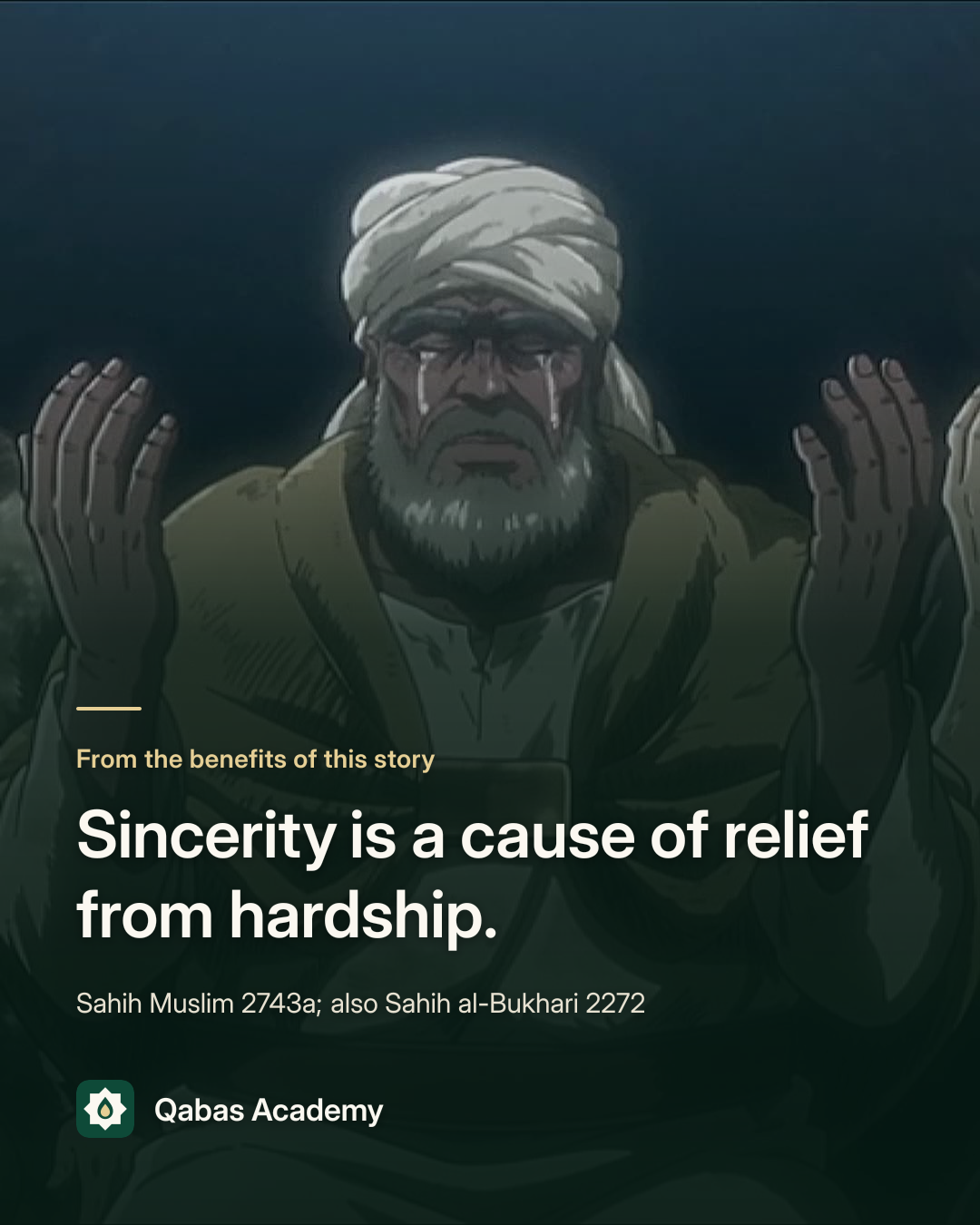
- Sincerity is a cause of relief from hardship.[4][5]
- The virtue of dutifulness to parents, of serving them and putting them before one's own children and spouse.[4][5]
- The virtue of chastity: refraining from what is forbidden while being able to do it, out of watchfulness and fear of Allah.[4][5]
- Chastity when one is able to sin is among the best deeds; Ibn Uthaymeen (vol. 1, pp. 82-83) says such a man may hope to be among the seven whom Allah shades on the day when there is no shade but His.[10]
- The virtue of fulfilling a trust, and of giving others their due without seeking anything in return; a warning against greed.[4][5]
- Leaving a sin wipes out the steps one took towards it, and repentance wipes out what came before it.[7]
- Whoever intends a bad deed and then leaves it for Allah's sake has it recorded as a good deed for him.[4]
- Allah hears supplication: He heard these men and answered them.[4]
- The virtue of keeping one's word, fulfilling a trust and being generous in dealings.[9]
- The Prophet (peace be upon him) told the stories of earlier nations so that listeners would follow what was good in them and avoid what was bad.[7]
- Showing off is like froth that passes away and benefits no one; every act of worship should be for Allah alone so that it is accepted.[10]
Reflection questions
These questions are written by Qabas Academy to help you reflect. They are not part of the hadith or its commentary.
- If you were trapped tonight, which of your deeds would you dare to mention?
- The second man stopped at the last possible moment. What helps a person stop when temptation is strongest?
- The third man grew a stranger's wage without being asked. Whose rights are in your hands right now?
- Why do you think each man said "if" he had done it for Allah's sake, rather than claiming it?
Reflection card
A card with one reflection from this episode and its source, ready to share.

More episodes
 1:47Hadith in AnimeThe Man Who Killed 99 People
 Now playing2:11Hadith in AnimeThe Three Men Trapped in the Cave
 2:04Hadith in AnimeThe Leper, the Bald Man and the Blind Man
 3:54Quran StoriesThe Day of Judgement
 17:11Quran StoriesThe Story of Prophet Yusuf (peace be upon him)
 1:31Hadith in AnimeThe Man Who Borrowed 1,000 Dinars