 English
 Español
 Русский
 中文
中文 Türkçe
 اردو
اردو Italiano
 Français
 Deutsch
Hadith in Anime
The Man Who Killed 99 People
Source & authenticity: Sahih Muslim 2766aSahih (authentic)
- Collection
- Sahih Muslim
- Narration
- Sahih Muslim 2766aIn-book reference: Book 50 (The Book of Repentance), Hadith 54
- Grading
- Sahih (authentic)HadeethEnc, Al-Durar al-Saniyyah
- Also reported in
- Sahih al-Bukhari 3470
Translation: Abdul Hamid Siddiqui
Open on sunnah.comHe took ninety-nine lives, then a hundred, and still the door of repentance stayed open.
Subtitles in 9 languages: choose yours with the CC button on the video. Watching needs no account.
The hadith
English translation by Abdul Hamid Siddiqui, as published on Sunnah.com. Sahih Muslim 2766a
Source & authenticity
- Narration
- Sahih Muslim 2766a (In-book reference: Book 50 (The Book of Repentance), Hadith 54)
- Also reported in
Sahih al-Bukhari 3470 (Book 60 (Prophets), Hadith 137)A shorter narration from the same Companion, Abu Sa'id al-Khudri; it adds that Allah commanded one land to draw near and the other to move away.
- Grading
Sahih (authentic)
Sources
- [1] Sahih Muslim 2766a, The Book of Repentance, Sunnah.com (accessed 2026-10-15)Arabic text and English translation (Abdul Hamid Siddiqui).
- [2] Sahih al-Bukhari 3470, Prophets, Sunnah.com (accessed 2026-10-15)Arabic text and English translation (Dr. M. Muhsin Khan).
- [3] HadeethEnc, hadith 4310 (English), Encyclopedia of Translated Prophetic Hadiths (accessed 2026-10-15)Explanation and grading.
- [4] HadeethEnc, hadith 4310 (Arabic), benefits of the hadith, Encyclopedia of Translated Prophetic Hadiths (accessed 2026-10-15)Benefits translated from Arabic by Qabas Academy.
- [5] Al-Durar al-Saniyyah, explanation of Sahih al-Bukhari 3470, Al-Durar al-Saniyyah (accessed 2026-10-15)Arabic explanation, summarised and translated by Qabas Academy.
- [6] Riyad as-Salihin 20, Chapter: Repentance (al-Nawawi), Sunnah.com (accessed 2026-10-15)
- [7] Ibn Hajar al-Asqalani, Fath al-Bari, vol. 6, pp. 597-598 (Book of the Prophets, commentary on Sahih al-Bukhari 3470), Islamweb.net library (accessed 2026-10-16)Arabic, summarised and translated by Qabas Academy.Pages opened: pp. 597-598
- [8] Al-Nawawi, Sharh Sahih Muslim (al-Minhaj), vol. 17, pp. 236-237 (Book of Repentance, chapter: the repentance of a killer is accepted even if he killed many), Islamweb.net library (accessed 2026-10-16)Arabic, summarised and translated by Qabas Academy.Pages opened: pp. 236-237
- [9] Muhammad ibn Salih al-Uthaymeen, Sharh Riyad as-Salihin, vol. 1, pp. 115-119 (Chapter of Repentance, hadith 20), Al-Maktaba al-Shamila (shamela.ws), Dar al-Watan edition, Riyadh 1426 AH, page numbers as printed (accessed 2026-10-16)Read on Shamela because binothaimeen.net does not publish this text online: its reading library offers only the index of the volume (official PDF, 10 pages), whose page numbers match this edition. Arabic, summarised and translated by Qabas Academy.Pages opened: p. 115, p. 116, p. 117, p. 118, p. 119
Explanation
- The man asked to be guided to the most knowledgeable person on earth, and was sent to a monk. HadeethEnc describes this monk as a worshipper "with little knowledge", who thought the sin too great to be forgiven.[1][3]
- Al-Durar al-Saniyyah explains that the monk made two mistakes: he narrowed the mercy of Allah, and he gave a ruling without knowledge.[5]
- Ibn Hajar notes in Fath al-Bari (vol. 6, p. 597) that the mention of a monk suggests the story took place after Jesus (peace be upon him) was raised, since monasticism was introduced by his followers. Ibn Uthaymeen adds in his commentary on Riyad as-Salihin (vol. 1, p. 117) that the monk was a worshipper without knowledge, who found the sin too great and answered that there was no repentance.[7][9]
- The scholar answered the opposite way: nothing stands between a person and repentance. He then gave practical advice: leave your land, which was a land of evil, and go to a land where people worship Allah, and worship Him with them. HadeethEnc notes that his own village "apparently was a land of disbelief".[1][3]
- Ibn Hajar (vol. 6, pp. 597-598) explains why the man killed the monk: the answer made him believe there was no way out for him, so he despaired of mercy; then Allah took hold of him, he regretted what he had done and went back to asking. He also points to the monk's lack of insight: facing a man who had made killing a habit, he should have been careful in how he answered him.[7]
- He died half way. In Muslim's narration the angels of mercy said he had come repentant, turning to Allah with his heart, and the angels of punishment said he had never done any good. An angel came to them in human form and told them to measure the distance between the two lands.[1]
- Ibn Uthaymeen (vol. 1, p. 117) explains the scholar's answer: the door of repentance is open. The land the man lived in seems, and Allah knows best, to have been a land of disbelief, so the scholar told him to emigrate with his religion to a town where Allah was worshipped.[9]
- In al-Bukhari's narration, Allah commanded the land he was heading for to draw near and the other to move away, and he was found one span closer, so he was forgiven. Al-Durar al-Saniyyah calls this part of the vastness of Allah's mercy towards His servants.[2][5]
- Ibn Hajar (vol. 6, p. 597) notes that in Muslim's narration the detail of him leaning his chest towards the land is reported by Qatada from al-Hasan at the end, which suggests they may be a narrator's addition rather than part of the Prophet's words.[7][1]
- A natural question is what happens to the rights of the people he killed. Al-Durar al-Saniyyah answers that the rights of people are not dropped without being settled, but when Allah is pleased with a sinner and accepts his repentance, He makes the wronged party pleased with him.[5]
- Al-Nawawi (vol. 17, p. 237) explains the angels' measuring: when the case was unclear to them and they disagreed, Allah commanded them to take as judge a man passing by, and the angel passed by in the form of a man and judged between them.[8]
- Imam al-Nawawi placed this hadith in the chapter on Repentance of Riyad as-Salihin (no. 20).[6]
- Ibn Uthaymeen (vol. 1, pp. 118-119) explains that a killing involves three rights. The right of Allah is forgiven through repentance. The right of the person killed is not restored by the killer's repentance, and Allah will judge between them on the Day of Resurrection. The right of the victim's heirs requires the killer to hand himself over to them and admit the killing, so that they may take retaliation, accept compensation, or forgive. Ibn Hajar (vol. 6, p. 597) likewise says that when Allah accepts a killer's repentance, He takes upon Himself to make his opponent pleased.[9][7]
- On the scholars' position: al-Nawawi (vol. 17, p. 236) states that the people of knowledge agree that the repentance of a deliberate killer is valid, and that only Ibn Abbas held otherwise; he adds that although this is a story of an earlier nation, our own law confirms it, citing the verses of Surat al-Furqan (25:68-70), which end with an exception for the one who repents. Ibn Uthaymeen (vol. 1, p. 118) calls the majority view the truth, and says Ibn Abbas's view can be understood as concerning the right of the person killed.[8][9]
Lessons and benefits
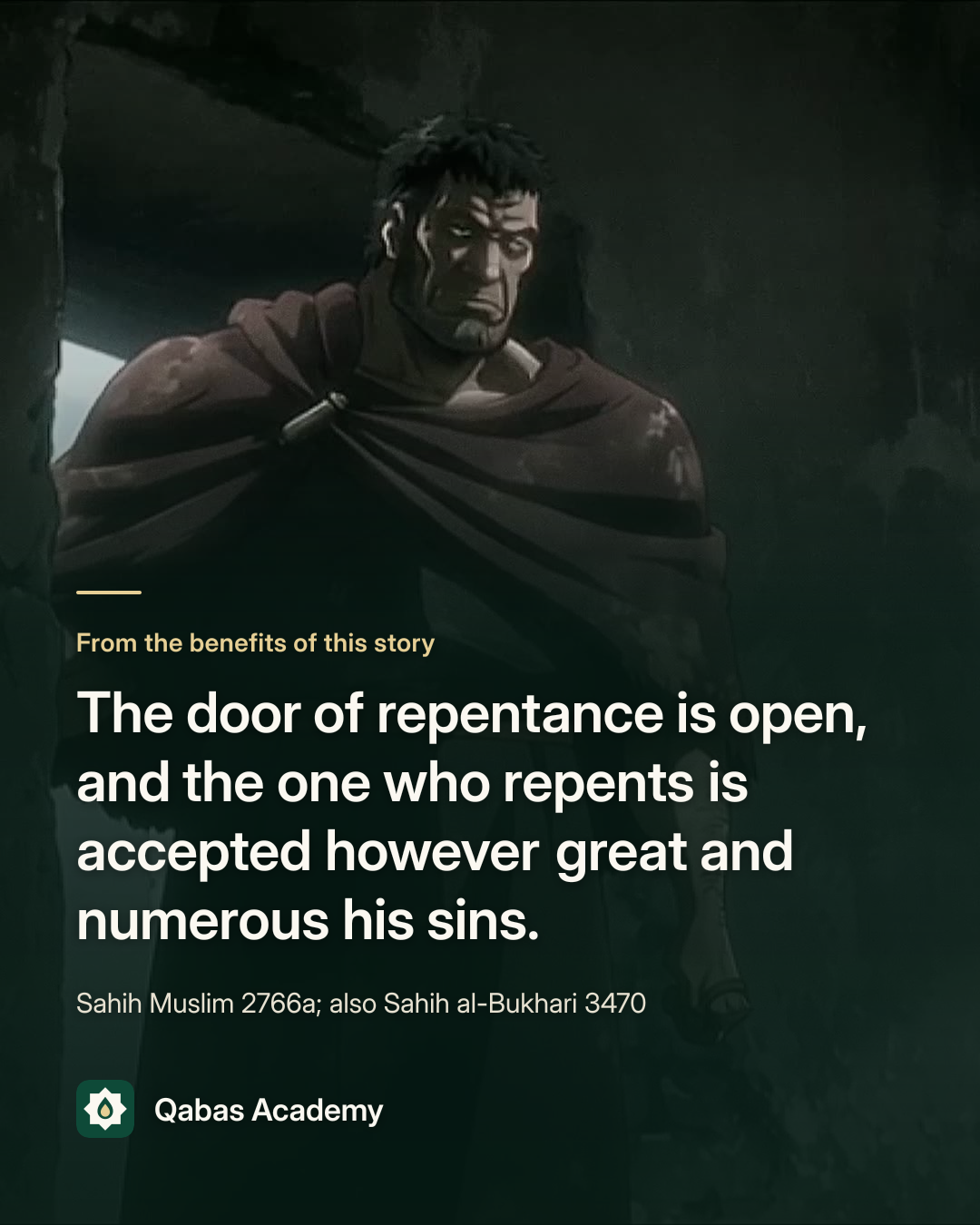
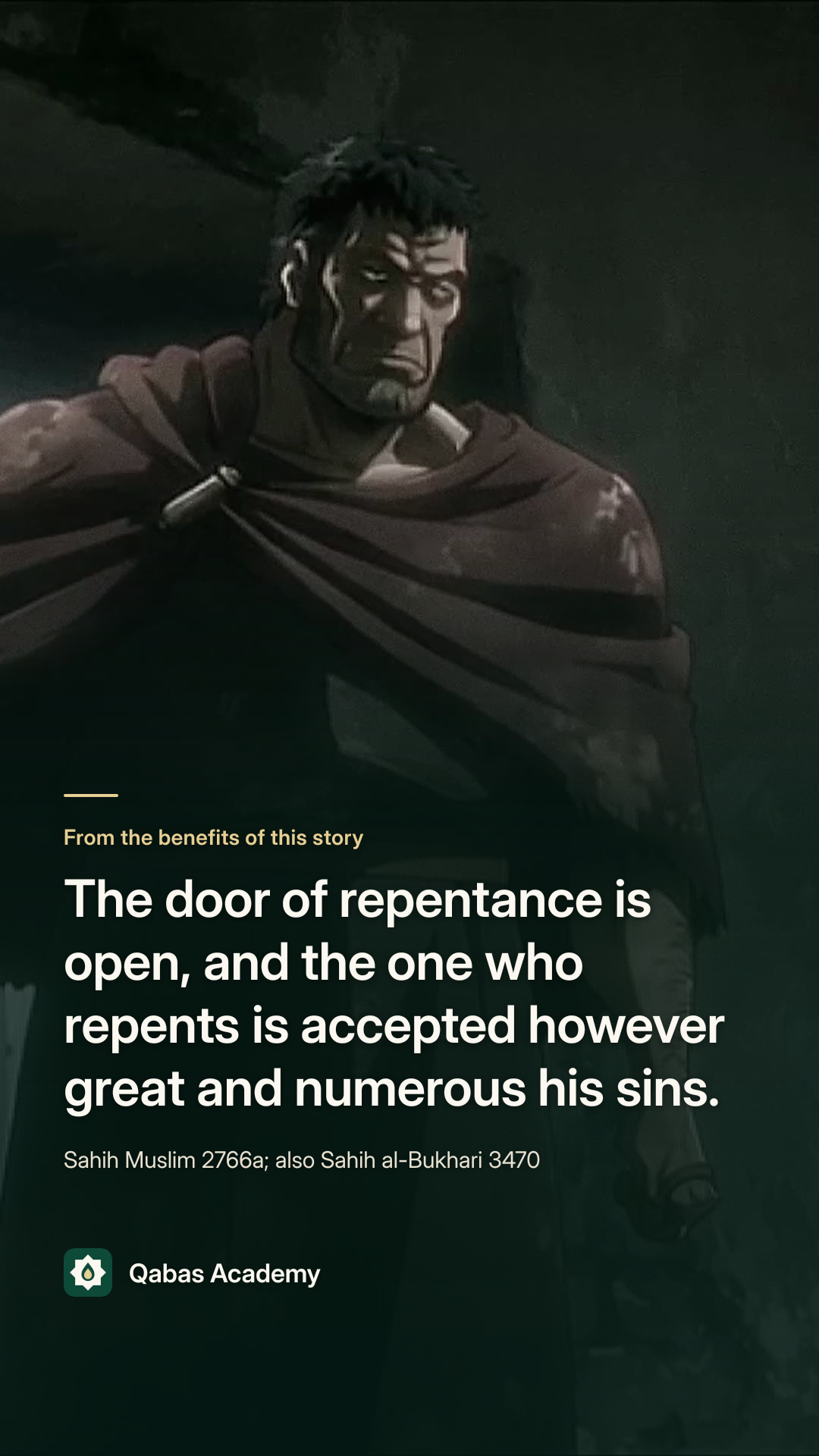
- The door of repentance is open, and the one who repents is accepted however great and numerous his sins.[4]
- Repentance is legislated for every major sin, even killing.[7]
- The repentance of someone who killed deliberately is accepted.[4]
- Knowledge with little worship is better than much worship with ignorance; the scholar is preferred over the worshipper.[4][5]
- Whoever calls others to good needs wisdom: to see what heals a soul and to lead it towards hope rather than despair.[4]
- Bad company is among the greatest causes of sin, and the company of obedient people among the greatest causes of obedience. Keep away from people of sin while they persist, and keep the company of people of piety, knowledge and righteousness.[5][4]
- The one who repents should leave the places where he sinned and the companions who helped him in it, keep away from them while they persist, and replace them with the company of good, knowledgeable and devout people; this strengthens his repentance. Ibn Hajar adds that he should leave behind the habits and circumstances of his time of sin.[8][7]
- Striving and bearing hardship to join the righteous is a sign that the wish to repent is sincere.[4]
- A person giving a ruling can answer wrongly; speaking about religion without knowledge has serious consequences.[7]
- Sinners are urged to repent and forbidden from despairing of Allah's mercy.[5]
- It supports the permissibility of arbitration: a judgment by someone both parties accept as arbiter is binding on them.[7][4]
Reflection questions
These questions are written by Qabas Academy to help you reflect. They are not part of the hadith or its commentary.
- The monk and the scholar heard the same question. What made their answers so different?
- The scholar told him to leave his land. What around you makes doing good harder, and what makes it easier?
- He died before he arrived. What does that say about how much the direction of a life matters?
- Is there someone you have quietly decided is beyond change?
Reflection card
A card with one reflection from this episode and its source, ready to share.
More episodes
 Now playing1:47Hadith in AnimeThe Man Who Killed 99 People
 2:11Hadith in AnimeThe Three Men Trapped in the Cave
 2:04Hadith in AnimeThe Leper, the Bald Man and the Blind Man
 3:54Quran StoriesThe Day of Judgement
 17:11Quran StoriesThe Story of Prophet Yusuf (peace be upon him)
 1:31Hadith in AnimeThe Man Who Borrowed 1,000 Dinars