 English
 Español
 Русский
 中文
 Türkçe
 اردو
 Italiano
 Français
 Deutsch
 العربية
Hadith in Anime
The Story of the Mother Who Lost Her Child
Sources: About this tellingSahih al-Bukhari 5999Sahih (authentic)
- Collection
- Sahih al-Bukhari
- Narration
- Sahih al-Bukhari 5999In-book reference: Book 78 (Good Manners and Form (Al-Adab)), Hadith 30
- Grading
- Sahih (authentic)Sahih al-Bukhari 5999, Sahih Muslim 2754, Ibn Hajar al-Asqalani, Al-Durar al-Saniyya, Sahih al-Bukhari 6000, Sahih Muslim 2752a, Sahih Muslim 2752c
- Verses
- 39:53
Translation: Dr
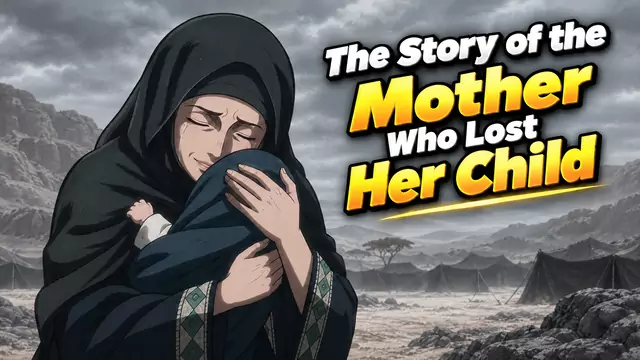
Open on sunnah.comThe hadith of the mother who lost her child, animated: a mother searches the captives' tents for her baby, and the Prophet Muhammad (peace be upon him) asks a question. After the Battle of Hunayn, captives are brought to the Prophet (peace be upon him). One woman, her hands empty, runs from tent to tent looking for her child, feeding every crying baby she finds. When she finds her son she holds him close. The Prophet asks his companions whether this woman would ever throw her child into the fire, and tells them: Allah is more merciful to His servants than this mother to her child. Then the hadith of mercy in one hundred parts, and the verse of the Quran that tells us never to lose hope in the mercy of Allah (Az-Zumar 39:53).
Original Arabic audio and 9 dubbed languages: choose with the audio button on the video, and subtitles with the CC button. Watching needs no account.
Chapters
The hadith and the verse
About this telling
The film tells this hadith in its own words, as a scene. Details such as the blue blanket she had woven, the old woman who wept with her, the words 'Not him' and the narrator's closing words are the film's telling, not words of the hadith. What is authentic is the hadith below, with the other narrations listed with it, and the verse of the Quran recited at the end.
Hadith
English translation by Dr. M. Muhsin Khan, as published on Sunnah.com. Sahih al-Bukhari 5999
Verses
Published translation consulted: Saheeh International, as shown on Quran.com.
Sources
About this telling
The film tells this hadith in its own words, as a scene. Details such as the blue blanket she had woven, the old woman who wept with her, the words 'Not him' and the narrator's closing words are the film's telling, not words of the hadith. What is authentic is the hadith below, with the other narrations listed with it, and the verse of the Quran recited at the end.
What is authentic in it
- Narration
- Sahih al-Bukhari 5999 (In-book reference: Book 78 (Good Manners and Form (Al-Adab)), Hadith 30)
- Also reported in
Sahih Muslim 2754 (Book 50 (The Book of Repentance), Hadith 26)The same narration of Umar ibn al-Khattab, through the same chain of narrators, in Muslim's chapter on how wide Allah's mercy is. Here the woman is searching («تَبْتَغِي»), and the companions' answer begins with an oath, «لاَ وَاللَّهِ», in Abdul Hamid Siddiqui's English on Sunnah.com: "By Allah, so far as it lies in her power, she would never throw the child in Fire." The film follows this wording when the companions say: No, by Allah, not while she is able not to.
Sahih al-Bukhari 6000 (Book 78 (Good Manners and Form (Al-Adab)), Hadith 31)The second hadith of the film, told by Abu Hurayra, in the chapter right after the mother's hadith. The film's words about the hundred parts of mercy and the mare that lifts her hoof away from her foal follow this wording (only this narration names the mare, «الْفَرَسُ»), in Dr. M. Muhsin Khan's English on Sunnah.com: "Allah divided Mercy into one hundred parts. He kept ninety nine parts with Him and sent down one part to the earth".
Sahih Muslim 2752a (Book 50 (The Book of Repentance), Hadith 20)The same hadith of the hundred parts in Muslim, told by Abu Hurayra, with «الدَّابَّةُ» (the animal) in place of the mare, in Abdul Hamid Siddiqui's English on Sunnah.com: "the animal lifts up its hoof from its young one, fearing that it might harm it."
Sahih Muslim 2752c (Book 50 (The Book of Repentance), Hadith 22)Another version of the same hadith, told by Abu Hurayra, which says what the ninety-nine parts are kept for: «وَأَخَّرَ اللَّهُ تِسْعًا وَتِسْعِينَ رَحْمَةً يَرْحَمُ بِهَا عِبَادَهُ يَوْمَ الْقِيَامَةِ», in Abdul Hamid Siddiqui's English on Sunnah.com: "Allah has reserved ninety nine parts of mercy with which He would treat His servants on the Day of Resurrection." The film's words about the ninety-nine mercies kept for the Day of Resurrection rest on this version.
- Grading
Sahih (authentic)
- Both al-Bukhari and Muslim, the two most trusted collections of the Prophet's sayings, recorded this hadith: al-Bukhari as no. 5999, in his book on good manners, in the chapter on being merciful to children, and Muslim as no. 2754, in his book on repentance. Both go back, through a chain of named narrators, to Umar ibn al-Khattab, a companion of the Prophet (peace be upon him). Ibn Hajar (Fath al-Bari, vol. 10, p. 444) notes that in both collections the hadith comes through the same narrator, Sa'id ibn Abi Maryam. Al-Durar al-Saniyya, an Arabic encyclopedia of hadith, reports it as sahih (authentic) and notes that Muslim's wording is slightly different.[1][2][8][6]
- The hadith of the hundred parts of mercy is also in both collections, told by Abu Hurayra: al-Bukhari no. 6000, in the chapter named after its first words, and Muslim no. 2752, in the chapter on how wide Allah's mercy is, with other versions (2752b, 2752c) that mention the Day of Resurrection. Every hadith in these two collections is accepted as authentic.[3][4][5]
- Verses
- Az-Zumar 39:53
- Published translation consulted
- Saheeh International, as shown on Quran.com
- Meaning in plain language (Qabas Anime)
- 39:53
- Tafsir
- Tafsir Ibn Kathir (Abridged), English, Quran.comAs-Sa'di, Taysir al-Karim ar-Rahman (Arabic), on Quran 39:53, Quran.com
Sources
- [1] Sahih al-Bukhari 5999, Good Manners and Form (Al-Adab), Sunnah.com (accessed 2026-10-26)Umar ibn al-Khattab's narration; Arabic text and English translation (Dr. M. Muhsin Khan).
- [2] Sahih Muslim 2754, The Book of Repentance, Sunnah.com (accessed 2026-10-26)Umar ibn al-Khattab's narration; Arabic text and English translation (Abdul Hamid Siddiqui).
- [3] Sahih al-Bukhari 6000, Good Manners and Form (Al-Adab), Sunnah.com (accessed 2026-10-26)Abu Hurayra's narration; Arabic text and English translation (Dr. M. Muhsin Khan).
- [4] Sahih Muslim 2752a, The Book of Repentance, Sunnah.com (accessed 2026-10-26)Abu Hurayra's narration through Sa'id ibn al-Musayyab; Arabic text and English translation (Abdul Hamid Siddiqui).
- [5] Sahih Muslim 2752c, The Book of Repentance, Sunnah.com (accessed 2026-10-26)Abu Hurayra's narration through Ata'; Arabic text and English translation (Abdul Hamid Siddiqui).
- [6] Al-Durar al-Saniyya, Encyclopedia of Hadith Commentary, sharh of Sahih al-Bukhari 5999 (page 85969), Al-Durar al-Saniyya (dorar.net) (accessed 2026-10-26)Arabic, under the supervision of the site's scholarly committee. The page opens with the version in Abu Nu'aym's Hilyat al-Awliya, then gives Sahih al-Bukhari 5999 with its grading, where it is recorded, and the explanation; summarised and translated by Qabas Anime.
- [7] Al-Durar al-Saniyya, Encyclopedia of Hadith Commentary, sharh of Sahih al-Bukhari 4318 (the captives of Hawazin, page 3449), Al-Durar al-Saniyya (dorar.net) (accessed 2026-10-26)Arabic; the background of the Battle of Hunayn and the return of the captives of Hawazin; summarised and translated by Qabas Anime.
- [8] Ibn Hajar al-Asqalani, Fath al-Bari, vol. 10, pp. 444-446 (Book of Good Manners, chapter: being merciful to a child, kissing and embracing him, commentary on Sahih al-Bukhari 5999), Islamweb.net library (page numbers as printed) (accessed 2026-10-26)Arabic, summarised and translated by Qabas Anime.Pages opened: pp. 444-446
- [9] Ibn Hajar al-Asqalani, Fath al-Bari, vol. 10, pp. 446-448 (Book of Good Manners, chapter: Allah made mercy one hundred parts, commentary on Sahih al-Bukhari 6000), Islamweb.net library (page numbers as printed) (accessed 2026-10-26)Arabic, summarised and translated by Qabas Anime.Pages opened: pp. 446-448
- [10] Al-Nawawi, Sharh Sahih Muslim (al-Minhaj), vol. 17 (Book of Repentance, chapter: how wide Allah's mercy is, commentary on Sahih Muslim 2754), Islamweb.net library (accessed 2026-10-26)Arabic, summarised and translated by Qabas Anime. Islamweb shows no printed page marker on this entry, so it is cited as a whole page.
- [11] Al-Nawawi, Sharh Sahih Muslim (al-Minhaj), vol. 17, p. 226 (Book of Repentance, chapter: how wide Allah's mercy is, commentary on Sahih Muslim 2752), Islamweb.net library (page numbers as printed) (accessed 2026-10-26)Arabic, summarised and translated by Qabas Anime.Pages opened: p. 226
- [12] Quran 39:53, Surah Az-Zumar, Quran.com (accessed 2026-10-26)English translation by Saheeh International. The Arabic shown on this page is the Tanzil Uthmani text (see arabic_source).
- [13] Tafsir Ibn Kathir (Abridged), English, Quran.com (accessed 2026-10-26)The abridged English translation of Ibn Kathir's Tafsir al-Qur'an al-'Azim, as shown on Quran.com under "Ibn Kathir (Abridged)". Summarised in our own words.Pages opened, by verse: 39:53
- [14] As-Sa'di, Taysir al-Karim ar-Rahman (Arabic), on Quran 39:53, Quran.com (accessed 2026-10-26)Arabic, as shown on Quran.com; summarised and translated by Qabas Anime. Quran.com shows this commentary verse by verse; this page is the commentary on the verse named.
Explanation
- The captives in this hadith were women and children of the Arab tribe of Hawazin. Ibn Hajar, the great scholar who explained al-Bukhari's collection, says so plainly (Fath al-Bari, vol. 10, p. 445), and al-Durar al-Saniyya also mentions it. Al-Durar al-Saniyya gives the background in its explanation of another hadith of al-Bukhari (no. 4318): in the eighth year after the Prophet had moved from Mecca to Medina, after Mecca had opened to him, the tribes of Hawazin and Thaqif gathered at Hunayn to fight him. They brought their wealth, their women and their children with them, so that no man would run away and leave his family behind. Allah gave the Prophet (peace be upon him) victory, and many captives were taken. Later, when people of Hawazin came to him as Muslims, he decided to give them back their captives.[8][6][7]
- Among the captives was a woman whose breasts were full of milk. Whenever she found a baby boy among the captives, she took him, held him close against her and fed him. Ibn Hajar (vol. 10, p. 445) explains what the words show: she had lost her own baby, and the milk building up in her breasts hurt her, so she fed any baby she found to ease the pain; then she found her own son, took him and held him close. In Muslim's version she was searching, and al-Nawawi, the great scholar who explained Muslim's collection, says both wordings are right: she was hurrying and searching for her son. Ibn Hajar adds that he found no name for the boy or for his mother.[1][2][8][10]
- The Prophet (peace be upon him) and his companions saw her. He asked them: "Do you think that this lady can throw her son in the fire?" They answered: "No, if she has the power not to throw it", that is, as long as she is able not to, she never would. Ibn Hajar (vol. 10, p. 445) explains: she would never throw him in of her own free will. In Muslim's version the companions begin with an oath: "By Allah, so far as it lies in her power, she would never throw the child in Fire."[1][2][8]
- Then the Prophet (peace be upon him) said: "Allah is more merciful to His slaves than this lady to her son." Here slaves means servants: the people who belong to Allah and worship Him. Ibn Hajar (vol. 10, p. 445) notes that in Arabic the sentence begins with a letter that gives it extra force, like saying: truly, Allah is more merciful. He explains (p. 446) that the Prophet used something people could see with their own eyes to help them understand something they cannot see: the mind cannot grasp Allah's mercy, so he brought it close to his listeners through this mother. Al-Durar al-Saniyya explains it the same way.[1][8][6]
- Who are His servants here? Ibn Hajar (vol. 10, p. 445) says it seems to mean, above all, those who die as believers, and he cites another narration in which the Prophet (peace be upon him) said that Allah will not throw someone He loves into the Fire; al-Durar al-Saniyya also explains it as the believers. Ibn Hajar also reports from the scholar Ibn Abi Jamra a second possible meaning: nothing is like the mercy of Allah, for anyone who has received a share of it, even animals. Ibn Abi Jamra draws a lesson from this: a person should rely on Allah alone in all his affairs, because whatever mercy we hope to find in anyone, Allah is more merciful than him, so a wise person takes his needs to the One whose mercy for him is greatest.[8][6]
- In the second hadith of the film, the Prophet (peace be upon him) said: "Allah divided Mercy into one hundred parts." He kept ninety-nine of them with Him and sent down one part to the earth, and from that one part all creatures are merciful to one another, so that even a mare lifts her hoof away from her foal so as not to step on it. Ibn Hajar (vol. 10, p. 447) reports Ibn Abi Jamra's explanation of why the mare is named: it was the animal people knew best and saw with its young, and although it is light and quick on its feet, it takes care not to hurt its foal. In another version, recorded by Muslim from the companion Salman, each one of these mercies fills all that is between the sky and the earth (p. 446). And the scholar al-Kirmani explains (p. 447) that the number one hundred is given to help us understand: to show how little of mercy is with all creatures, and how much is with Allah.[3][4][9]
- What are the ninety-nine parts kept for? Another version in Muslim says: "Allah has reserved ninety nine parts of mercy with which He would treat His servants on the Day of Resurrection", the day when all people are brought back to life and judged. In Salman's version, on that day Allah adds the one part of this world to them, to make a hundred (Ibn Hajar, vol. 10, p. 447). Al-Nawawi (vol. 17, p. 226) calls these hadiths words of hope and good news: if one single mercy in this world, a world full of troubles, gives people faith, the Quran, prayer and mercy in their hearts, then imagine a hundred mercies in the next life. Ibn Hajar (p. 448) adds that the hadith encourages faith and widens our hope in the mercy Allah has kept, and he quotes another narration: if a disbeliever knew all the mercy that is with Allah, he would not lose hope of Paradise.[5][9][11]
- The film ends with the first words of a verse of the Quran (Az-Zumar 39:53), in which Allah tells the Prophet to say to people who have wronged themselves by sinning that they must not lose hope in Allah's mercy, because Allah forgives all sins. Ibn Kathir, in his commentary on the Quran, explains that this verse is a call to every sinner, whether a believer or not, to repent and turn back to Allah; and that one must never lose hope in Allah's mercy, even if one's sins are many and great, because "the door of repentance and mercy is expansive", that is, wide open. He reports that the companion Ibn Mas'ud called it the verse of the Quran that brings the most relief. The scholar as-Sa'di explains: do not lose hope and say that your sins are too many to be wiped away; know that Allah forgives all sins, great and small, and that the way to His forgiveness and mercy is to turn back to Him sincerely and ask Him.[12][13][14]
Lessons and benefits
- The greatest mercy we know on earth, a mother's love for her child, is only a small sign of Allah's mercy, which the mind cannot fully grasp.[1][8]
- Take your needs to Allah first: whatever mercy you hope to find in people, Allah is more merciful than them.[8]
- The mercy people and animals show one another, and the mercy in your own heart, are gifts from the one part of mercy Allah sent down to the earth.[3][11]
- Live with hope: Allah has kept ninety-nine parts of His mercy for the Day of Resurrection, and the scholars call these hadiths good news.[5][11][9]
- Never lose hope in Allah's mercy, however many your mistakes: the door back to Him is wide open.[12][13][14]
- Hope is not a reason to stay where you are: the way to Allah's forgiveness is to turn back to Him sincerely and ask Him.[14]
- A good teacher explains what cannot be seen with what can be seen: the Prophet (peace be upon him) taught about Allah's mercy through a mother in front of his companions.[8][6]
Reflection questions
These questions are written by Qabas Anime to help you reflect. They are not part of the hadith, the Quran or their commentaries.
- Think of the most loving person in your life. What changes in you when you remember that Allah is more merciful to you than they are?
- The mother fed every crying baby she found while she searched for her own. When you are in pain, what helps you still be kind to others?
- All the mercy in the world comes from one part out of a hundred. Where did you see that mercy this week, in a person or even in an animal?
- Is there a mistake that has made you feel too far from Allah to come back? What would it mean for you to hear: do not lose hope in His mercy?
Transcript
The words of the episode, from the English subtitles of the original voice.
A mother, searching every tent, and every face, for her little child. The Prophet (peace be upon him) and his companions saw her, and he said words that would never be forgotten.
Umar ibn al-Khattab, may Allah be pleased with him, narrates that captives were brought to the Prophet (peace be upon him), women and children of the tribe of Hawazin. And the Prophet (peace be upon him) was watching them. Among them was a woman, her hands empty, unable to sit, unable to rest. The war had torn her away from her child. She ran between the tents, lifting the curtains, looking into the face of every child. Not him. Her chest was so full of milk that it hurt her. Whenever she saw a crying baby, she took him, and fed him from her milk. And when his mother came, she gave him back, and went on searching. And the Prophet (peace be upon him) and his companions were watching her. Suddenly, she heard crying, a cry she knew well. She saw the blue blanket she had woven with her own hands. It was her son. She rushed to him, took him, held him close, fed him from her milk, and his crying stopped. She wept with joy, and the old woman wept with her. A moment no words can describe. Then the Prophet (peace be upon him) said to his companions: “Do you think this woman would throw her child into the fire?”
They said: “No, by Allah, not if she can help it.” He (peace be upon him) said: “Allah is more merciful to His servants than this woman is to her child.” And on another occasion, he (peace be upon him) said: “Allah made mercy one hundred parts. He kept ninety-nine parts with Him, and sent down one single part to the earth. From that one part, all creatures show mercy to one another, so that a mare lifts her hoof away from her foal, afraid that she might hurt it.” All of this mercy comes from just one part. And Allah has kept ninety-nine mercies, with which He will show mercy to His servants on the Day of Resurrection. So do not despair. Allah is more merciful to you than your own mother. Say: “O My servants who have wronged themselves, do not despair of the mercy of Allah.” (Az-Zumar 39:53)
Related episodes


More episodes
 Now playing2:46Hadith in AnimeThe Story of the Mother Who Lost Her Child
 12:54Quran StoriesThe Cow That Exposed a Killer
 4:42Hadith in AnimeThe Man Who Gave Charity Three Nights
 7:32Hadith in AnimeThe Boy and the King
 7:17Hadith in AnimeJuraij and His Mother's Prayer
 3:30Quran StoriesThe Story of Gog and Magog
 2:28Hadith in AnimeThe Hadith of Jibril
 3:49Islamic StoriesThe King and the Grateful Minister
 1:47Hadith in AnimeThe Man Who Killed 99 People
 2:11Hadith in AnimeThe Three Men Trapped in the Cave
 2:04Hadith in AnimeThe Leper, the Bald Man and the Blind Man
 3:54Quran StoriesThe Day of Judgement
 17:11Quran StoriesThe Story of Prophet Yusuf (peace be upon him)
 1:31Hadith in AnimeThe Man Who Borrowed 1,000 Dinars